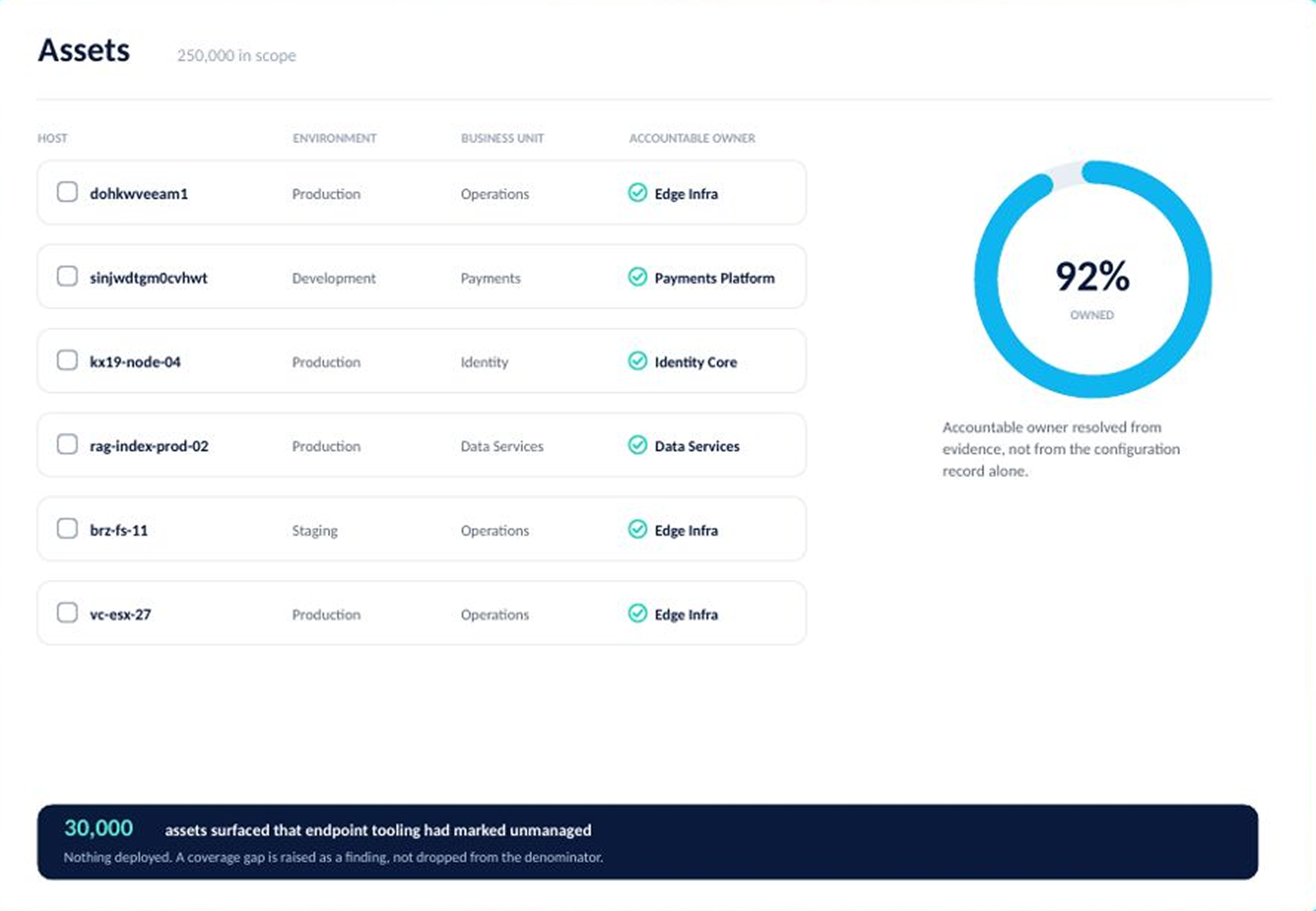
Ownership, not just inventory
The accountable owner resolved from partial




Discovery is the easy half. Every row below is a problem of identity, attribution or currency, which is the half no inventory tool automated.
A union of four lists is still four lists.
Aggregation gives you one view. It does not give you one identity, so the same host still arrives four times.
The owner field is a name, not an owner.
It is populated once when the asset is built and rarely again, so it ages out of date faster than anything else in the record.
Inventory tools report what they can see.
An asset with no agent goes missing from the numerator and the denominator at once, which flatters every coverage number downstream.
A record is accurate on the day it is built.
Ghost assets linger after decommissioning, and a new class of asset waits on a schema change before it can be counted at all.
One asset, resolved from evidence.
Every source is interrogated and scored against the others, so four reports of one host become one asset carrying four pieces of evidence.
Ownership is a property, not a lookup.
The accountable team is part of the record rather than something a person researches each time a ticket needs to be routed.
A coverage gap becomes assigned work.
The asset is raised as an exposure and routed to whoever can install the agent, rather than reported as a percentage that belongs to nobody.
The record keeps itself current.
Assets that stop appearing are retired, and inference endpoints, retrieval pipelines and model artifact stores enter as assets with no schema change.
Work routes to the accountable team without a reassignment cycle, which is where a remediation ticket loses its first week.
No agent, no scanner, no network sweep. Nothing to roll out across the estate, and nothing to keep running once it is there.
Every coverage number security, IT and audit report rests on the same record, so the meeting is about the gap rather than the count.
The record is rebuilt continuously from evidence, so it reflects the estate today rather than the last time a discovery cycle happened to run.
End of life and end of support arrive with lead time, which turns a lifecycle problem into a planned change instead of an incident.
None of this requires the configuration database to be correct first, which is the prerequisite most asset programs quietly stall on.
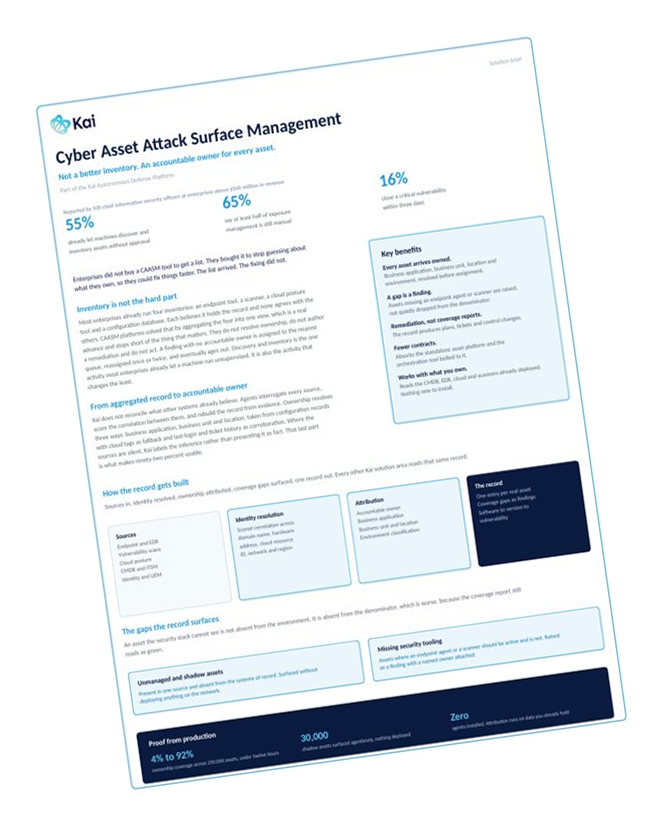
Most enterprises already run an endpoint tool, a vulnerability scanner, a cloud posture tool and a CMDB, and each of them believes it holds the asset inventory. None of them agrees with the others, because each defines an asset differently and each sees a different slice of the estate. The result is not one inventory with gaps. It is four overlapping partial inventories with no shared identity and noreconciliation between them.
The more consequential gap is ownership. A finding without an accountable owner goes to whichever queue is nearest, is reassigned once or twice, and ages out. Asset management platforms solved theunion problem, one view across sources, and left the attribution problem open.
1 Kai, 2026 State of Autonomous Defense, a survey of security leaders.
2 Kai customer engagements. Ownership figures are from a Fortune 50 energy company.
Six systems.
Six inventories.

Owner fields, often stale

Agents, and the hosts marked unmanaged

Resource tags, inconsistently applied

Who actually logs in

What each one can reach

Repositories and pipelines
Interrogated, not reconciled.
Every source, every field, with its timestamp. Nothing is nominated as the system of record
Last login, ticket history and cloud tags corroborate the record or overrule it
Where sources are silent or disagree, the answer says so rather than posing as a fact
One row per asset, rebuilt.
The accountable team, corroborated

Production, development, test

And the unit that pays for it

Agent present, scanner reach

End of life and end of support, with lead time
Ownership coverage moved from four percent to 92% across 250,000 assets in under twelve hours at a Fortune 50 energy company. 30,000 shadow assets surfaced in a single estate without an agent.
Kai does not scan and does not try to be your discovery layer. It reads the inventories you already run: endpoin tmanagement, vulnerability assessment, cloud posture, source control and the CMDB. Identity resolves by scored correlation across domain name, hardware address, cloud resource ID, network address and region, so one host arriving from four tools is one asset and not four.
Three tiers: business application, business unit, and location, taken from configuration records, with cloud tags as fallback where the CMDB is silent, and last login and ticket history as corroboration. Where sources conflict, Kai labels the inference rather than presenting it as a recorded fact. Conceding that the answer is sometimes probabilistic is what makes ninety-two percent usable.
An asset with no endpoint agent, or one missing from the scanner meant to cover it, is raised as an exposure rather than dropped from the denominator. Every downstream capability resolves against this model and inherits its gaps, so a partial inventory understates risk everywhere at once.

Asset identity resolved by scored correlation across multiple signals rather than by trusting any single source of record.

Three-tier attribution to business application, business unit and location, built to produce a usable answer from partial inputs.

Ownership is expressed in the terms the owner process already uses, so the resulting ticket routes without human triage.

Assets missing an endpoint agent or a scanner are surfaced before every downstream analysis silently inherits the gap.
Six capabilities built on the assumption that every source you already run is partial and that several of them disagree. That assumption is the product.
Scored correlation across domain name, hardware address, cloud resource ID, network address and region
Kai does not nominate a system of record and trust it. Every source is interrogated, the correlation between them is scored, and the asset is rebuilt from what the evidence supports. The configuration database is treated as one opinion among several.
The Difference
One host arriving from four tools resolves to one asset, including the hosts no single source holds acomplete row for.
Business application, business unit and location, corroborated by last login and ticket history
Attribution runs from configuration records with cloud tags as fallback, then corroborates against who has actually been logging in and who has been receiving the tickets. It is built to produce a usable answer from partial inputs rather than a blank field from clean ones.
The Difference
Ownership coverage moved from four percent to ninety two percent across 250,000 assets in under twelve hours at a Fortune 50 energy company.
A probabilistic answer marked as one, rather than promoted to a fact
Where sources conflict or fall silent, Kai states what it inferred and on what basis. Conceding that the answer is sometimes probabilistic is a deliberate design choice, not a shortfall in the data.
The Difference
Ninety two percent is usable rather than merely reported, because the owning team can see which attributions are corroborated and which are not.
Nothing deployed, read only access to the inventories you already run
Assets your endpoint tooling has quietly marked unmanaged, and assets no tool reports at all, are surfaced and brought into the record with the same identity and ownership treatment as everything else.
The Difference
30,000 shadow assets surfaced in a single customer estate without an agent and without a network scan.
A missing endpoint agent or scanner treated as an exposure, not an omission
An asset with no agent, or one missing from the scanner meant to cover it, is raised rather than dropped from the denominator. A partial inventory understates risk everywhere at once, and it does so silently.
The Difference
The denominator is honest, so every coverage percentage downstream of this record means what it says.
Exposure management, validation, remediation and detection resolve against the same asset
There is no second inventory and no per use case asset model. Environment classification and software lifecycle, resolved to version with end of life and end of support lead time, are inherited by everything that reads the record.
The Difference
Every other Kai use case inherits this model, which is why ownership does not have to be solved again forremediation, validation or detection.
The estate is answered in days, not quarters
An asset program normally opens with a cleanup phase. This opens with an answer and cleans up from there.
Coverage evidence assembles itself
What an auditor asks for is a query against the record rather than a spreadsheet three teams reconcile by hand.
The asset tool absorbs its workflow layer
The standalone asset platform and the orchestration bolted onto it stop being two separate renewals.
You can show what you own
A defensible inventory with named accountability is the artifact most frameworks ask for and most companies assemble by hand.