Exposure management is how security teams decide which weaknesses actually matter and make sure those get fixed. It replaces the question "how many findings do we have?" with a harder one: "what can an attacker use against us right now, and how long has it been open?"
What is exposure management?
Exposure management is the continuous practice of finding, validating, prioritizing and fixing the weaknesses an attacker could actually use to reach something valuable. It covers every asset class, not just software vulnerabilities: unpatched CVEs, misconfigurations, over permissioned identities, exposed services, unmanaged assets and shadow IT, risky SaaS settings and missing controls. Success is measured by how long the organization stays exposed, not by how many findings it logs. In this glossary the term means exposure management in cybersecurity, not the insurance or treasury meaning.
Key takeaways
Exposures are broader than CVEs. Misconfigurations, identities, unmanaged assets and missing controls count too.
Fewer exploitable paths, not fewer tickets. The goal is less usable risk, not a shorter list.
Discipline, framework, tooling. Exposure management is the discipline, CTEM is a framework for running it, and platforms are the tooling. You can't buy the framework.
Programs stall at the last mile. Most get stuck between "confirmed" and "fixed".
Agentic AI is moving the work into the platform. Remediation and interim detection are shifting from ticket queues to agents working inside boundaries people set.
Why it matters
Scanners report far more findings than any team can fix, and only a small share of vulnerabilities are ever exploited. The CISA Known Exploited Vulnerabilities catalog lists vulnerabilities with confirmed exploitation in the wild, and it covers a small fraction of published CVEs. FIRST's Exploit Prediction Scoring System estimates the probability of exploitation, and most vulnerabilities score low. Working a list in severity order spends most of the effort on findings no attacker will use.
At the same time, the window to act is closing. Mandiant estimates mean time to exploit at negative seven days in its 2026 report, which means exploitation now routinely starts before a patch exists. AI is compressing the expertise, time and money that exploitation once required. The metric that matters is the exposure window: how long an exploitable weakness stays open. Patch counts and ticket counts describe activity. The exposure window describes risk.
Exposure management compared with vulnerability management
Exposure management builds on vulnerability management rather than replacing it. Vulnerability management supplies the findings. Exposure management adds reachability, compensating controls, ownership and validation, and it measures success differently.
Attribute
Vulnerability management
Exposure management
Scope
Known software vulnerabilities (CVEs)
Any condition an attacker can use, including misconfigurations, identities and unmanaged assets
Asset coverage
Assets the scanner already knows about
Infrastructure, cloud, code, identities, SaaS and the internet facing attack surface
Data sources
One or a few scanners
Scanners, asset inventories, cloud and identity sources and threat intelligence, combined and deduplicated
Prioritization basis
Severity, usually CVSS
Exploitability (KEV, EPSS, reachability) plus business context
Validation
Rare; findings are assumed real
Each exposure checked for reachability and a working attack path
Remediation ownership
Ticket to a queue; owner often unclear
Accountable owner identified before the fix is assigned
Cadence
Periodic scan cycles
Continuous
Success metric
Findings closed, SLA compliance
Time exposed, exploitable paths removed
The biggest practical difference is ranking. CVSS measures how severe a vulnerability could be in general. Exploitability based ranking asks whether it can be exploited here: is it in the KEV catalog, what does EPSS predict, is the vulnerable code reachable, how critical is the asset, and is a compensating control already in place? Risk based vulnerability management moved in this direction. Exposure management finishes the move and extends it beyond CVEs.
Exposure management compared with CTEM
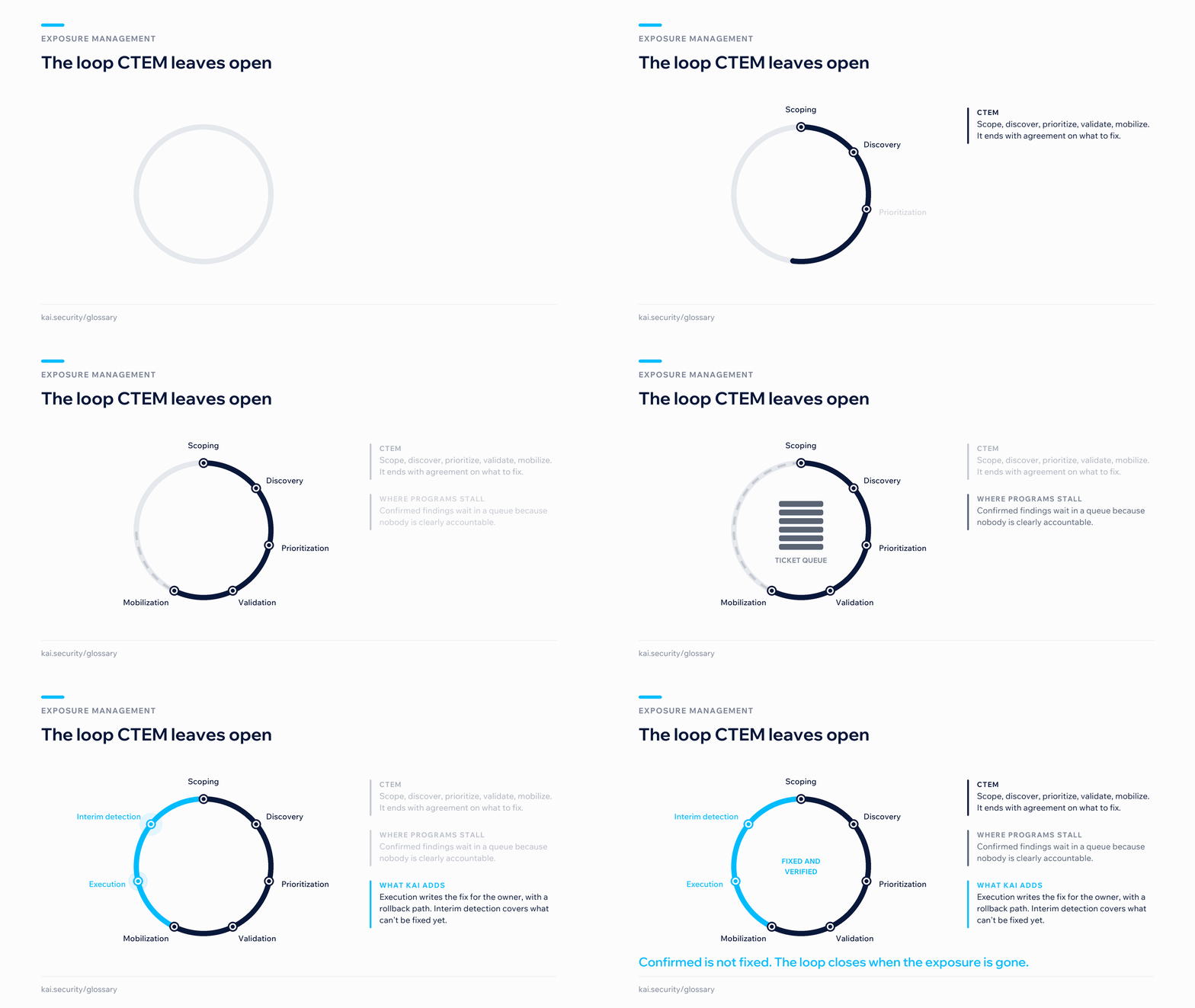
Continuous threat exposure management (CTEM) is an operating model for running exposure management, organized as five repeating stages. Scoping decides which business services and attack surfaces matter most. Discovery finds the assets and exposures in that scope, including ones no tool tracks. Prioritization ranks them by exploitability and business impact. Validation confirms an attacker could actually use an exposure and shows what it would reach. Mobilization gets the people who own the fix to act.
CTEM ends with agreement on what to fix, and that is where most programs stall: confirmed findings sit in ticket queues because nobody is clearly accountable, and work stops at the boundary between security and IT. Kai adds two phases to close the loop. Execution writes the specific fix for each asset and delivers it to the accountable owner, with sequencing and a rollback path. Interim detection keeps exposures that can't be fixed yet under detections written for that exposure until the fix lands.
Confirmed is not fixed. The loop closes when the exposure is gone.
Exposure management compared with attack surface management
Attack surface management finds and inventories the assets an attacker could target, and external attack surface management does it from the outside, the way an attacker would. Exposure management starts from that inventory and goes further: it identifies the weaknesses on those assets, validates which are exploitable, assigns owners and drives fixes. Attack surface management answers "what do we have?" Exposure management answers "what can be used against us, and is it fixed?"
A worked example
A vulnerability in an internet facing edge device is added to the KEV catalog on a Monday. The device has no recorded owner, and the next maintenance window for its network segment is two weeks away. Discovery ties the device to a business application: it fronts remote access for the finance team. Ownership attribution assigns an accountable team from evidence across endpoint, identity, cloud and CMDB records, instead of the finding being reassigned until it ages out. Validation confirms the attack path: the device is reachable from the internet, the vulnerable component is exposed, and the device can reach a system holding sensitive data.
The patch has to wait for the window, so interim controls cover the gap. The owner restricts access to the management interface, and a detection written for this exposure watches for exploitation attempts. When the patch lands, a fresh check confirms the attack path is gone and the finding closes with its evidence attached. A ticket based process would have reported success the moment the ticket was opened. Exposure management reports how long the organization was exposed before the path was covered, and how long before it was gone.
Exposure management software and threat exposure management platforms
Exposure management software, often called a threat exposure management platform, aggregates findings from existing scanners and asset sources, deduplicates them, adds exploitability and business context, and drives remediation. Most platforms ingest the scanners a team already owns rather than replacing them.
Several categories make up an exposure management stack. Exposure assessment platforms unify vulnerability and exposure assessment across asset types. CAASM builds an accurate asset inventory with owners. External attack surface management discovers internet facing assets. Adversarial exposure validation tests whether exposures can actually be exploited. Unified exposure management combines several of these in one platform. Whatever the category, the core capabilities are the same: discovery and inventory across domains, normalization and deduplication, ownership mapping, exploitability based prioritization, validation, remediation workflow and measurement.
How to evaluate CTEM solutions
CTEM solutions should be judged on whether they connect diagnosis to action. CTEM is an operating model and most organizations assemble it from several tools, so the deciding question is not whether one product covers every stage.
Coverage and ownership. It should work across the scanners and asset sources you already own, and attribute every asset to an owner with evidence you can check.
Validation in your environment. Exploitability and reachability should be proven on your assets, with compensating controls taken into account, not inferred from a generic score.
Execution, not just ticketing. Look for remediation that produces the specific change, interim detection for what can't be fixed yet, and verification that each fix landed.
Governance for autonomy. Any autonomous action needs approval boundaries, an audit trail and rollback.
Proof of concept numbers. Measure the share of findings removed as not exploitable before human review, ownership coverage, and median time exposed for validated critical exposures.
Agentic AI and autonomous remediation
Exposure management is shifting from scoring and reporting to AI agents that investigate findings, write fixes, route them to owners and add detections for what can't be fixed yet. This is the work that has historically stalled in ticket queues, and it is where autonomous remediation fits.
Kai's approach is a binary decision on every exposure. The Kai Autonomous Defense Platform ingests findings from the scanners a team already runs, proves which are exploitable, and either fixes each one or stages it for a person, inside a boundary the team sets. Kai states that this removes 90% or more of findings on exploitability before human review, up to 99% depending on environment and scanner mix, and that it raised ownership coverage from 4% to 92% across 250,000 assets in under 12 hours. Autonomy only works with guardrails: deterministic, human defined action boundaries, approval for anything outside them, a read only start that widens as evidence builds, and a record of every action with its reason, rollback path and proof.
Common misconceptions
That exposure management is rebranded vulnerability management. It builds on vulnerability management, but it covers exposures that have no CVE and judges every exposure on exploitability and business context.
That you can buy CTEM as a product. CTEM is an operating model. Platforms support it; they don't replace the process or the people who own the fixes.
That prioritization is the finish line. A ranked list changes nothing until someone fixes the exposure and verifies the fix.
That a lower finding count means lower risk. Closing hundreds of low risk findings can leave one exploitable path wide open.
That autonomous remediation means no human oversight. People set the boundaries, approve what falls outside them, and can audit every action.
Standards and sources
The CTEM model was introduced by Gartner in 2022. Exploitability evidence draws on the CISA Known Exploited Vulnerabilities catalog and FIRST's Exploit Prediction Scoring System, and severity on FIRST's Common Vulnerability Scoring System. Time to exploit figures come from Mandiant's 2026 threat report. Kai performance figures are stated by Kai.
FAQ
What is the difference between exposure management and CTEM? Exposure management is the discipline of finding and fixing the weaknesses attackers can use. CTEM is a specific operating model for running that discipline in five repeating stages: scoping, discovery, prioritization, validation and mobilization. You practice exposure management; CTEM is one structured way to practice it continuously.
Do exposure management platforms patch automatically? Some can, within limits. Most create and track tickets. Newer agentic platforms write the specific change, stage it for the owner with a rollback path, and act on their own only inside boundaries the security team defines. Anything outside those boundaries should require human approval, and every action should leave an audit trail.
What metrics show an exposure management program is working? The most useful measure is time exposed: how long a validated, exploitable weakness stays open. Supporting metrics include the share of findings removed as not exploitable before human review, ownership coverage across assets, and the number of attack paths to critical systems. Ticket counts and SLA compliance describe activity, not risk reduction.
What is the difference between exposure management and attack surface management? Attack surface management finds and inventories the assets an attacker could target. Exposure management starts from that inventory and goes further: it identifies the weaknesses on those assets, validates which ones are exploitable, assigns an accountable owner and drives each fix to verified closure. One tells you what you have. The other tells you what can be used against you.
How long does it take to stand up an exposure management program? A first cycle can run in weeks if the scope is narrow, such as internet facing assets or one critical business service. Connecting existing scanners and asset sources, resolving ownership and agreeing on remediation boundaries take the most time. Expand scope cycle by cycle rather than covering the whole estate at once.
Sources
Gartner, Implement a Continuous Threat Exposure Management (CTEM) Program, 2022.
CISA, Known Exploited Vulnerabilities Catalog, 2026.
FIRST, Exploit Prediction Scoring System (EPSS), 2026.
FIRST, Common Vulnerability Scoring System (CVSS), 2026.
Mandiant, M Trends, 2026.
Kai, Kai Autonomous Defense Platform, 2026.
Next steps
Exposure management is measured by exposures closed, not findings logged. The programs that work close the gap between confirmed and fixed, and they can show how long each exploitable path stayed open.