Every handoff keeps exposures open longer
Patch orchestration was solved years ago, provided somebody hands it a plan. The plan is still written by a person, so the finding goes out as a ticket to a team that rebuilds it from scratch, in a window it has to find, for an asset it may not own.
of organizations close a critical vulnerability within three days of identifying it.
Source: Kai, 2026 State of Autonomous Defense report. Wakefield Research survey of 500 security leaders at $500M+ organizations, June 2026.
Fixes that your team can approve, not tickets it has to decode
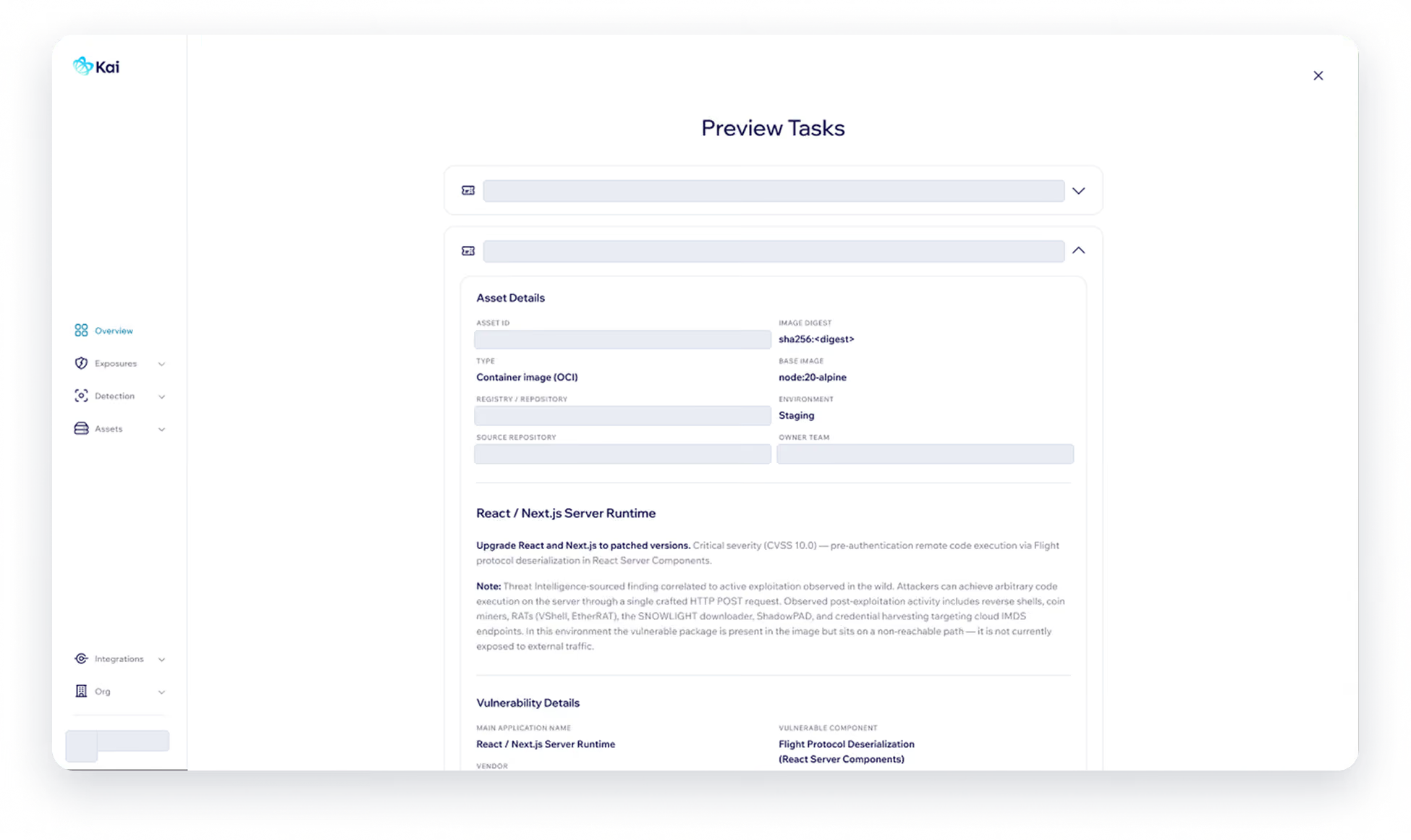
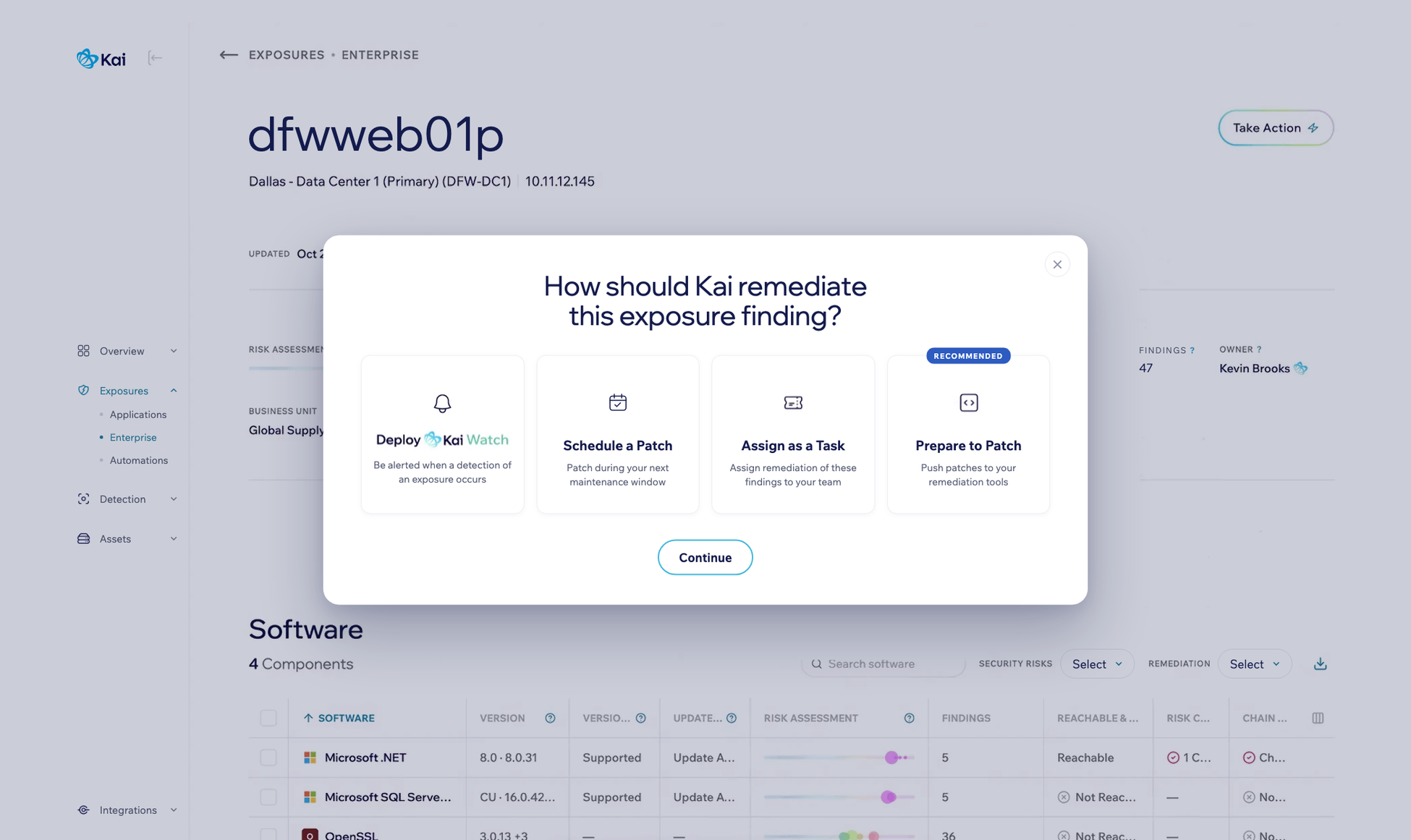
Kai turns each validated exposure into the specific change and routes it to the accountable owner, inside the boundary you set.

The specific fix per asset: target version, ordering, prerequisites and rollback path
Predictive impact analysis before any fix runs
Exposures close without adding headcount
Staged with the owner named, so nobody rebuilds the plan
IT approves a staged change on evidence, with a rollback path attached
Your orchestrator and ticketing stay in place
Your engineers stop rebuilding the plan for every fix
1
2
3
4
7+ days
4 hand-offs
1 to 2 days
2 to 3 days of tickets
1 day

1 to 2 days
scheduled
next scan cycle
Minutes
1 hand-off
minutes, inside your boundary
the same window
next scan read


Human-led durations are illustrative. Survey figure: 60% of CISOs report more than seven days to remediate a critical vulnerability (Kai 2026 State of Autonomous Defense report).
From a ticket to decode to a change to approve

A ticket that says patch this
The plan rebuilt by every receiving team
Change windows found by hand
Weeks between a finding and a fix
A change ready to approve
Planned once, centrally, with the owner named
Impact known before approval
A rollback path and evidence on every change
Approve with confidence, because every change carries its proof
Owner resolved before assignment. Nothing is authored speculatively.

Target version, ordering, prerequisites. Rollback path and blast radius labeled.

set per environment, asset class and change type
The change lands in the first window. A full audit trail is recorded with the rollback path and the evidence that justified it.
Nothing moves. The change is staged in the system the team already works in, and approval stays with a person.
Enforced, not advisory. Widen it at your own pace.
A maintenance window, a vendor dependency or a freeze blocks the fix. Kai keeps the change staged with its owner and window, and a detection can be written for the exposure in the meantime.

Frequently asked questions
Does Kai patch production systems by itself?

Yes, inside a boundary you set by environment, asset class and change type. Kai authors the change, runs it through the tooling you already use and records the rollback path and the evidence that justified it. Outside that boundary, the change is staged for the accountable owner to approve.
What does authoring the change actually mean?
Kai writes the specific fix per asset: target version, ordering, prerequisites, blast radius and rollback path. The receiving team gets a change to approve rather than a ticket to interpret, so nobody rebuilds the plan from scratch.
What happens when a patch is blocked?
Kai keeps the change staged with its owner and its window, so nobody rebuilds the plan when the window opens. In the meantime, Kai selects compensating controls for the exposure, and Detection Intelligence writes a rule for it in the SIEM or EDR you already run.
Does Kai replace our orchestrator or ticketing?
No. Kai replaces the human step in front of the orchestrator, not the orchestrator. Changes arrive as pull requests or tickets in the workflows your engineers already use, and your orchestrator still pushes them.
How do we audit what Kai did?
Every change carries what changed, when, under whose authority, the evidence behind it and its rollback path. Every finding removed from the queue carries a written reason.