

Threats understood. Detections written.
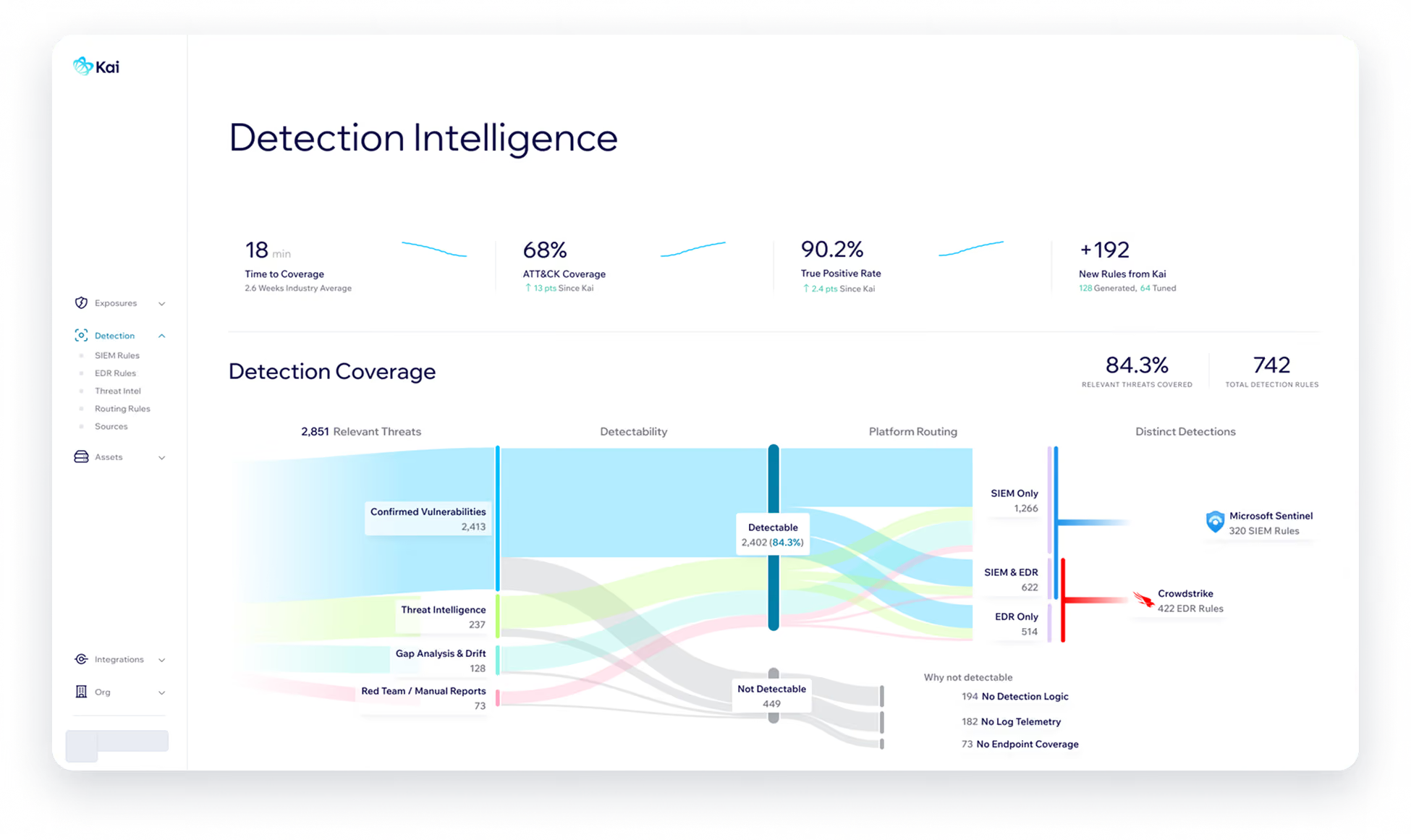
Your rule count grows while real exposures go unwatched
A feed streams general threat intel, a technique looks relevant enough, then a rule is written and shipped. Over the years the rule set grows into the hundreds and coverage is reported as a count of irrelevant protections, while the exposures you genuinely have have nothing watching them at all.
of CISOs name trust in automated decisions as the top barrier to more automation.
Source: Kai, 2026 State of Autonomous Defense Report. Wakefield Research survey of 500 security leaders at $500M+ organizations, June 2026.
Coverage for the exposures you actually have, with fewer false alarms
Kai writes, validates and maintains the rules that watch your real exposures, in the SIEM and EDR you already run.

Rules converted to your SIEM’s language and validated against your schema
Event types tiered Hot, Warm or Cold, for lower SIEM cost with the same coverage
Rules tuned or retired when they no longer apply
Threat intel matched to the software you run, for defense before a CVE is published
Coverage reported as exposures watched, not rules deployed
Detection coverage that scales without headcount
Your SOC gets rules that earn every alert
1
2
3
4
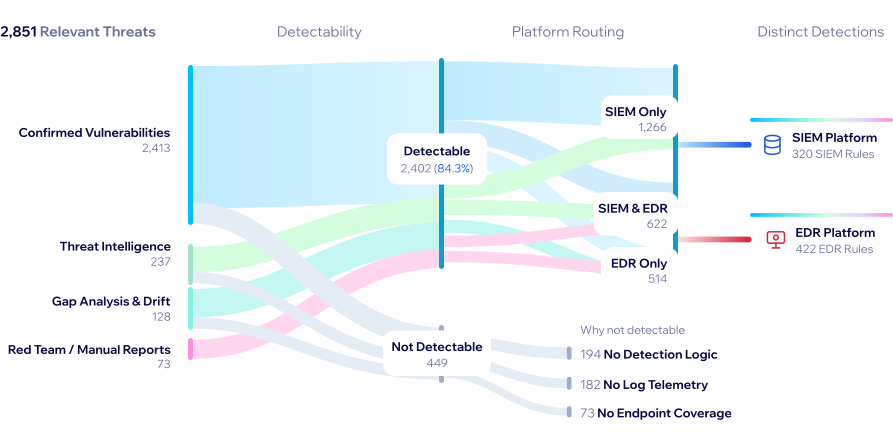


From a rule count to coverage you can prove

A threat feed that says what exists in the world
Generic rules that assume telemetry you may not have
Rules added and almost never retired
Coverage reported as a rule count
Coverage matched to confirmed exposures
Rules written against fields you collect
Noise that falls instead of accumulating
Coverage reported as exposures watched
False positives from 74% to 12%
Kai rewrote and tuned the rule set against the environment’s own telemetry, and authored more than 70 rules in two hours.
Ship detections without adding noise to your SOC

Frequently asked questions
How does Kai decide which threats need a detection?

Kai ingests advisories, exploit activity and threat reporting continuously and tests each technique for applicability: the software is present, the configuration permits it, and the telemetry exists to detect it. Only then is a rule written. Techniques that cannot apply in your environment never become rules.
What language are the rules written in?
The query language of the SIEM or EDR you already run, so nothing has to be translated or re-platformed. Rules are deployed only where the exposure is open rather than across the whole estate.
How do you keep alert volume under control?
Every rule passes several stages of validation before it ships: it fires on the events it is scoped for, ignores the ones it should not, and its alert volume is known in advance rather than discovered in production. Rules are measured once live and retired when they stop earning their alerts. One production SOC saw its false positive rate fall from 74% to 12%.
How fast can coverage be in place?
In minutes. In one engagement more than 70 rules were authored in moments, giving coverage for exposures that could not be patched inside the window.


