


Blog
11.18.26
16 Reflections of a CISO: Kai at [un]prompted

Alfredo Hickman
CISO

When the speed of attack changes
A significant portion of the research and discussion at [un]prompted focused on the rapidly advancing ability of AI to discover, analyze and exploit software vulnerabilities. We are seeing meaningful progress in the ability of AI systems to reason through complex codebases, identify weaknesses, chain multiple vulnerabilities together, develop potential exploitation paths, and automate work that historically required substantial human expertise, time and resources.
From a technical perspective, these advances are fascinating. From a security leadership perspective, they should command our attention.
For decades, discovering and exploiting complex vulnerabilities required a combination of specialized expertise, significant resources and time. Increasingly capable AI systems are compressing all three. Reliable autonomous exploitation from end to end still faces practical limits, but the direction is difficult to ignore.
What concerns me is not simply that AI will help attackers find more vulnerabilities. It is that AI can change the operational tempo of an attack in a way traditional security systems were never designed to absorb.
The time between vulnerability discovery and attempted exploitation is likely to keep shrinking. As these capabilities mature, adversaries will be able to evaluate more targets, explore more attack paths, and operationalize what they find with greater speed.
Now consider what that means for the average enterprise security program. We already live with growing backlogs, fragmented tooling, competing engineering priorities, tightening budgets, talent shortages, and remediation that can take weeks or months. If adversaries are working in minutes and hours, those approaches stop being sustainable.
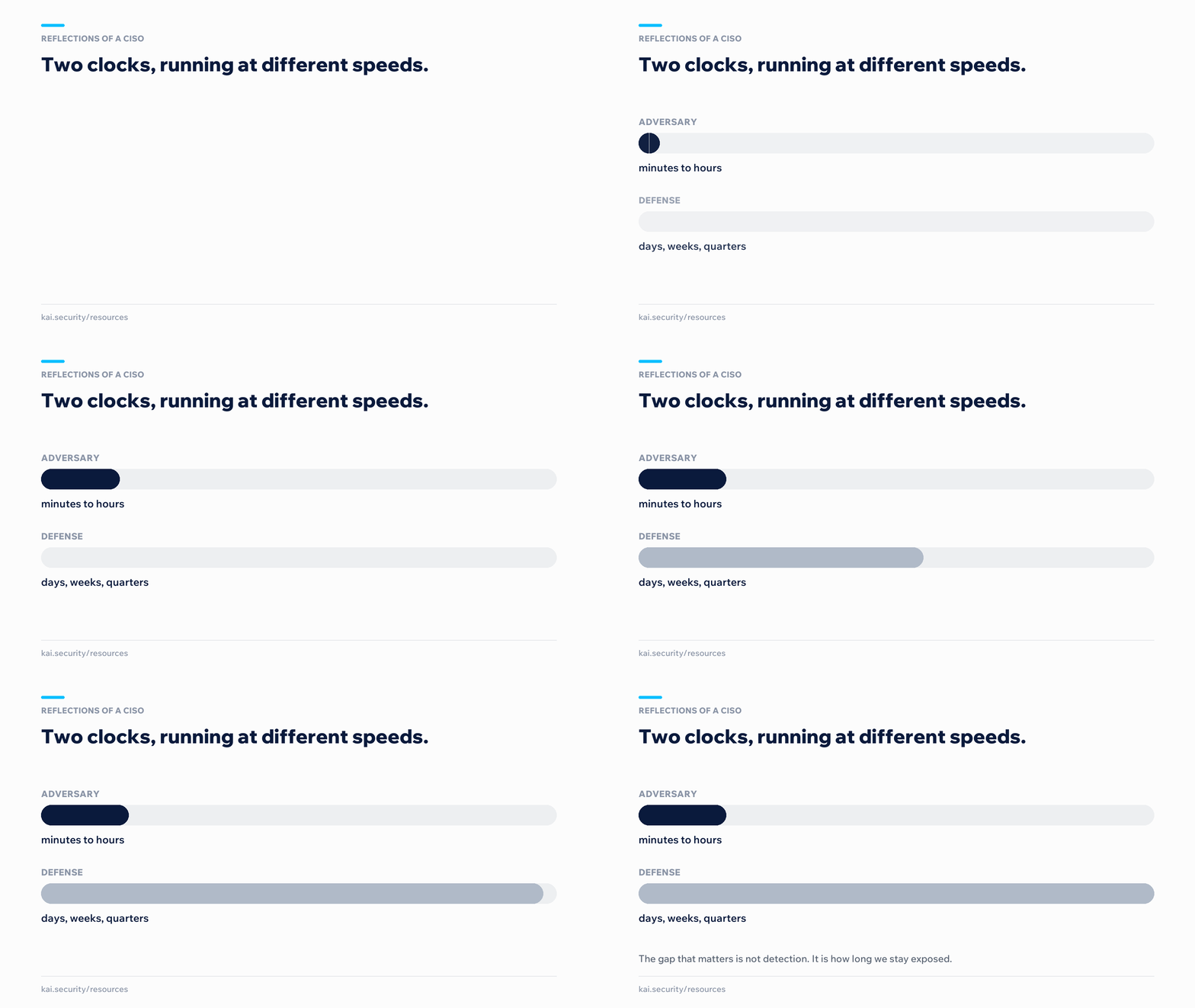
The question is no longer just how quickly we can discover vulnerabilities. It is how quickly we can eliminate exploitable risk before an adversary can act.
Having spent much of my career operating, building and leading security programs for the cloud, SaaS and AI eras, I know the challenge facing defenders extends well beyond technology. Security organizations work inside real constraints: finite resources, complex environments, business priorities, compliance obligations, and the need to balance risk management against operational efficiency.
We have become very good at measuring security activity. We count vulnerabilities, assign severity ratings, track remediation tickets, measure SLA compliance, and report progress to executives and boards. Those measurements serve a purpose. I have come to believe they do not always reflect what matters most, which is whether we are reducing meaningful exposure faster than an adversary can exploit it.
A team can meet every remediation SLA and still leave a critical attack path open for an unacceptable length of time. Reducing the total count of vulnerabilities does not necessarily reduce business risk by the same amount.
We need to evolve beyond managing findings and toward continuously eliminating exploitable risk. That starts with understanding which vulnerabilities actually matter in the context of our own environments, and it cannot stop there. We also have to improve how quickly we move from identification to validation, remediation and verification.
Consider the traditional lifecycle of a vulnerability. A tool identifies an issue. An analyst investigates it. Someone decides whether it is relevant. An engineering team receives a ticket. A fix gets developed. Eventually the change is tested and deployed, hopefully inside the SLA.
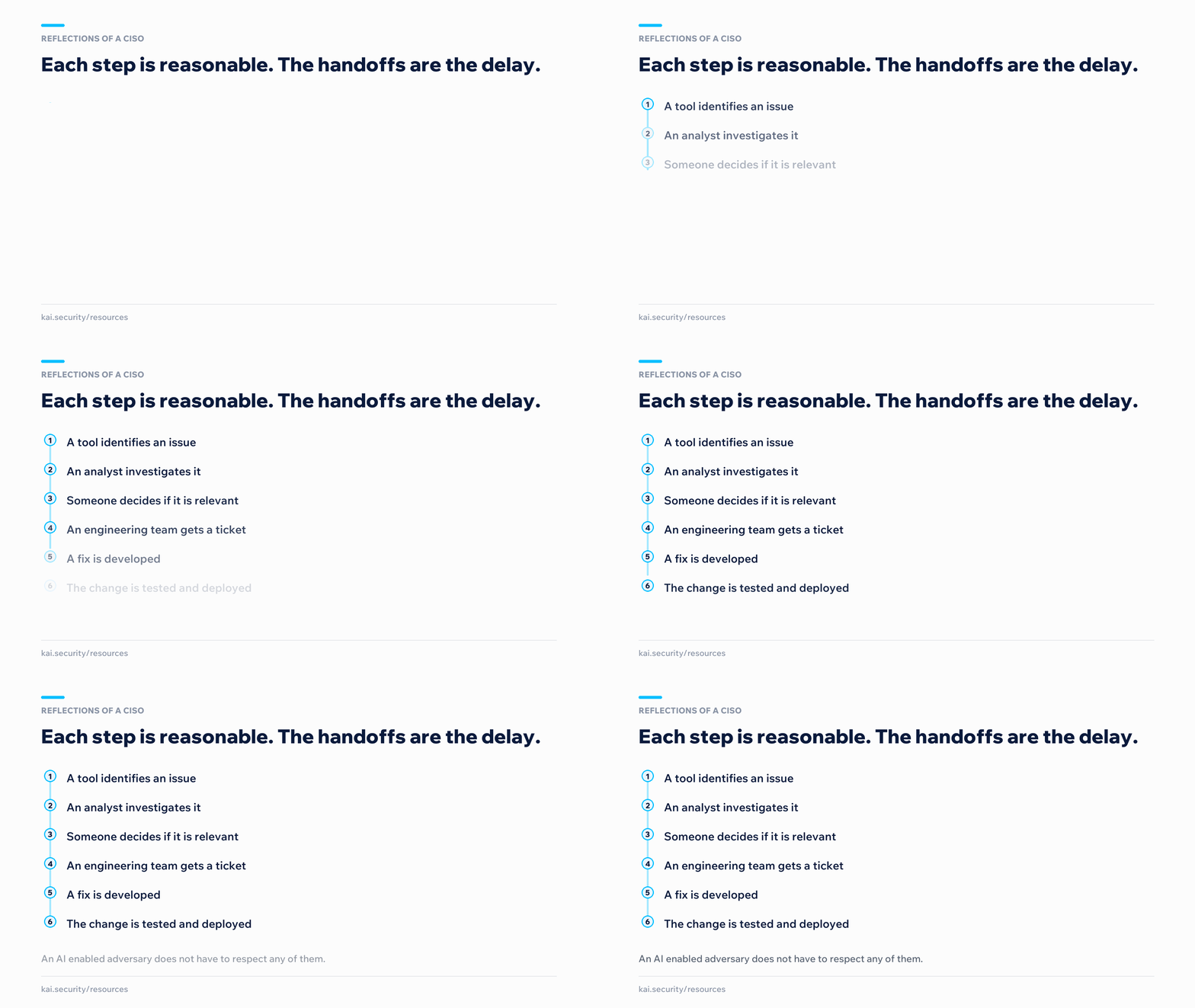
Each step is reasonable on its own. Together, those handoffs introduce delay that an AI enabled adversary does not have to respect.
This is where I see one of the biggest opportunities for AI native security. Rather than helping analysts work through the existing process more efficiently, we have a chance to redesign the process.
Picture a program where intelligent systems continuously assess the environment, understand the relationship between a vulnerability and business risk, validate actual exposure, and initiate remediation inside clearly defined operational boundaries. The practitioner's role shifts from manually managing every step to setting the policies, guardrails and strategy that let defensive systems operate safely at machine volume and velocity.
Human judgment remains essential. We must not check our brains and our critical thinking at the door in this new age, particularly when a decision carries real business or operational risk. But we should challenge the assumption that every security action requires human intervention, especially when the pace of the threat demands a faster answer.
From a hands on perspective there is another distinction that deserves attention.
Much of the excitement around offensive AI research comes from discovering unknown vulnerabilities or generating working exploits. Those are meaningful technical achievements, and they show how quickly the underlying capability is advancing. But finding a vulnerability and eliminating the risk it represents are two very different problems.
In real environments, remediation takes more than identifying vulnerable code or suggesting a patch. We need to know whether the vulnerability is actually reachable and exploitable, which systems and services are affected, what the business impact might be, and how to implement a fix without introducing unintended consequences. Then we test the change, deploy it safely, and verify that the original exposure is gone.
Anyone who has spent time in the trenches knows how hard that is across large environments with multiple technology stacks, legacy dependencies and competing operational demands.
So what if we could bring discovery, contextual analysis, exploitability validation, remediation, testing and verification into one continuous defensive workflow? Instead of asking practitioners to stitch together findings from disconnected tools, AI native systems could reason across the environment, determine the appropriate action, and execute validated remediation inside established security and operational guardrails.
Doing that reliably is far harder than generating a patch. AI systems make mistakes. Proposed fixes introduce regressions. A change executed incorrectly can cause operational damage as significant as the vulnerability it was meant to address.
This is why trustworthy autonomy matters. A defensive system has to demonstrate not only that an action is technically possible, but that it is appropriate, authorized, validated and safe to execute at scale.
The opportunity I find most exciting is not an AI system that finds thousands of vulnerabilities in a fraction of the time. It is one that can reliably identify a meaningful exposure, determine the right corrective action, execute or orchestrate it safely, and verify the outcome. Finding a vulnerability is an important step. Eliminating the exploitable condition is what reduces risk.
One of my strongest takeaways from [un]prompted was how much attention and innovation is being directed at the offensive applications of AI. That research is important, and understanding how adversaries might use these capabilities is essential to preparing a defense. But I left thinking about the other side of the equation.
If AI can discover and exploit vulnerabilities at machine speed, why should defenders not use the same advances to discover, validate and remediate even faster? Why should we accept that attackers hold the inherent advantage in an AI native world?
That is the kind of question that makes the work of Kai Labs worth doing. The next generation of security cannot simply be the traditional stack with AI layered on top. We have an opportunity to rethink the problem from first principles, starting from the outcomes defenders need rather than the limits of the tools and workflows we inherited. That means challenging long standing assumptions about how security information is collected, how vulnerabilities are prioritized, how remediation decisions get made, and why so many defensive actions still depend on fragmented, human driven process.
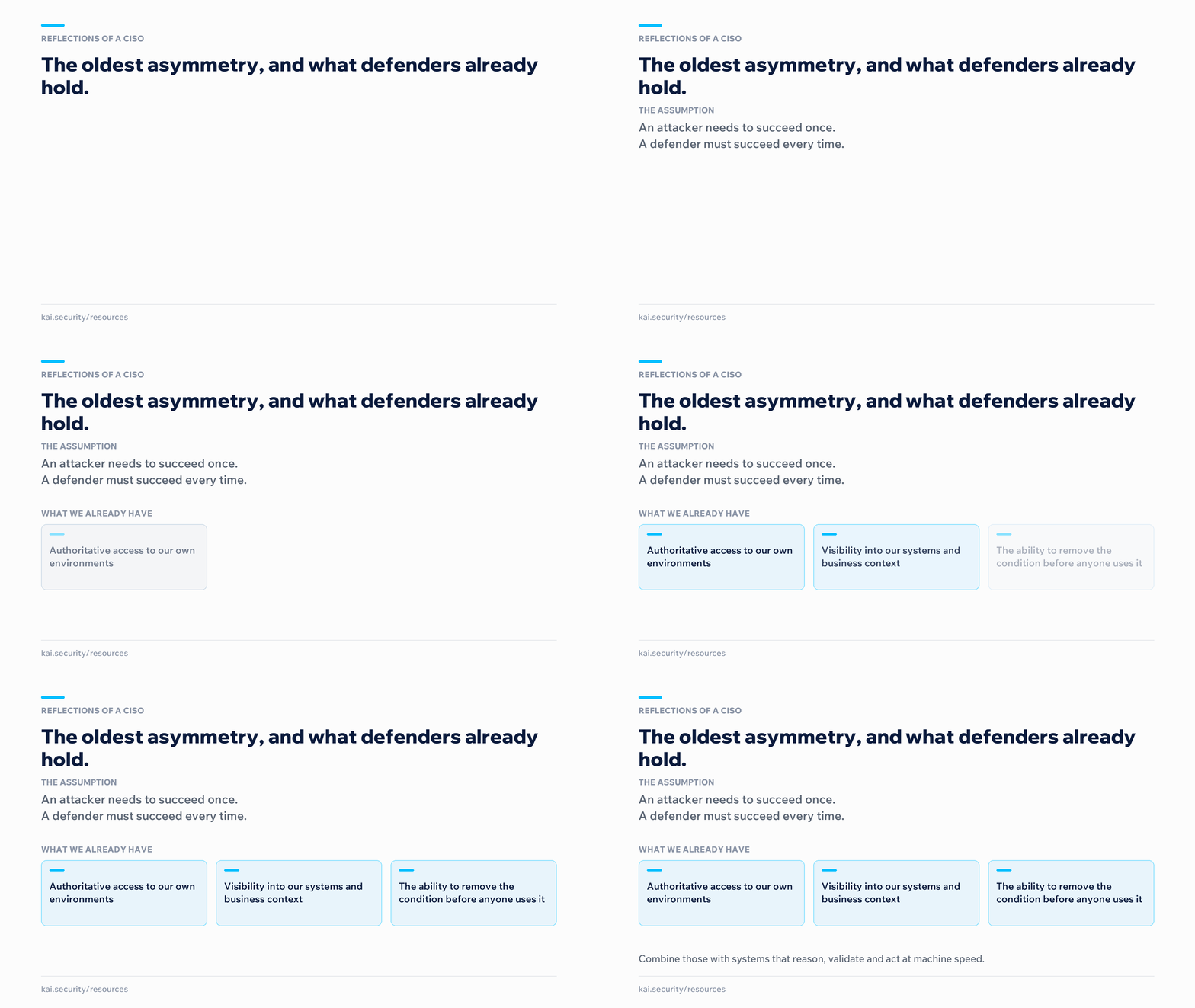
Most importantly, AI native security lets us challenge one of this industry's oldest asymmetries: the idea that an attacker needs to succeed once while a defender must succeed every time.
That imbalance has always favored the adversary. But defenders hold advantages we routinely underuse. We have authoritative access to our own environments. We have visibility into our systems and our business context. We can remove a vulnerable condition before anyone exploits it. Combine those with systems that reason, validate and act at machine speed, and the dynamics start to change.
Imagine the discovery of a new exploitable weakness triggering a continuous defensive response that identifies affected systems, evaluates the remediation options, implements validated protection, and confirms the exposure is gone, inside a window that challenges an adversary's ability to operationalize the same vulnerability. That is the asymmetric advantage defenders should be pursuing.
None of this happens overnight, and we should not underestimate the engineering and security work involved in building autonomous defense that organizations can actually trust.
As we give AI systems greater responsibility and access inside our environments, we have to make sure they operate within well defined security boundaries. Agent identity, authorization, least privilege access, runtime protection, auditability and human oversight all become more important, not less. We cannot introduce new attack surface and new operational risk in the pursuit of defensive speed.
As both a CISO and a practitioner, I believe our responsibility is to adopt these capabilities thoughtfully, with the same rigor we expect of any technology trusted to protect critical systems. The goal should not be autonomy at any cost. It should be a trustworthy, intelligent defense that operates at a speed and scale traditional approaches cannot match.
I left [un]prompted encouraged by the caliber of the innovation and the passion of the people advancing this industry. It was also a reminder that while the offensive implications of AI are significant, we should be just as ambitious about what these technologies make possible for defenders.
The future of security does not have to be an endless cycle of sharper attacks and defenses that cannot keep pace. We are not working to help defenders do the same things faster. We are working toward a different model entirely, one designed from the ground up to give defenders the advantage.
That is the whole mission at Kai.


