


Blog
11.18.26
ARTEX and the Case for Autonomous Defense

Kylie McClanahan, PhD
Research Director

On 13 November the FBI published a FLASH on ARTEX, an open source agentic penetration testing framework that threat actors have been running in live intrusions since at least August 2026. The technical detail is interesting. The number that matters is the clock. The Bureau records intrusions moving from initial targeting to privileged access in under three hours, and Google's incident data has one case at fifteen minutes. No approval workflow, no change window and no on call rotation operates on that scale. I do not read this as an argument for working harder inside the existing model. I read it as the end of that model. If the attack executes autonomously, the defense has to execute autonomously too, inside boundaries you set and can prove. The foundations still decide the outcome, and the people still decide whether the foundations hold.
FLASH-20261113-001 is worth reading in full, and it is marked TLP:CLEAR, so you can circulate it freely.
ARTEX is an autonomous, multi agent platform written in Go. It takes an objective in natural language and translates it into machine commands executed by specialized sub agents, with almost no human involvement after the operator sets the goal. It carries no model of its own. It calls out to whatever is available, and the advisory names Anthropic Claude, OpenAI GPT, DeepSeek, GLM, Grok and Kimi.
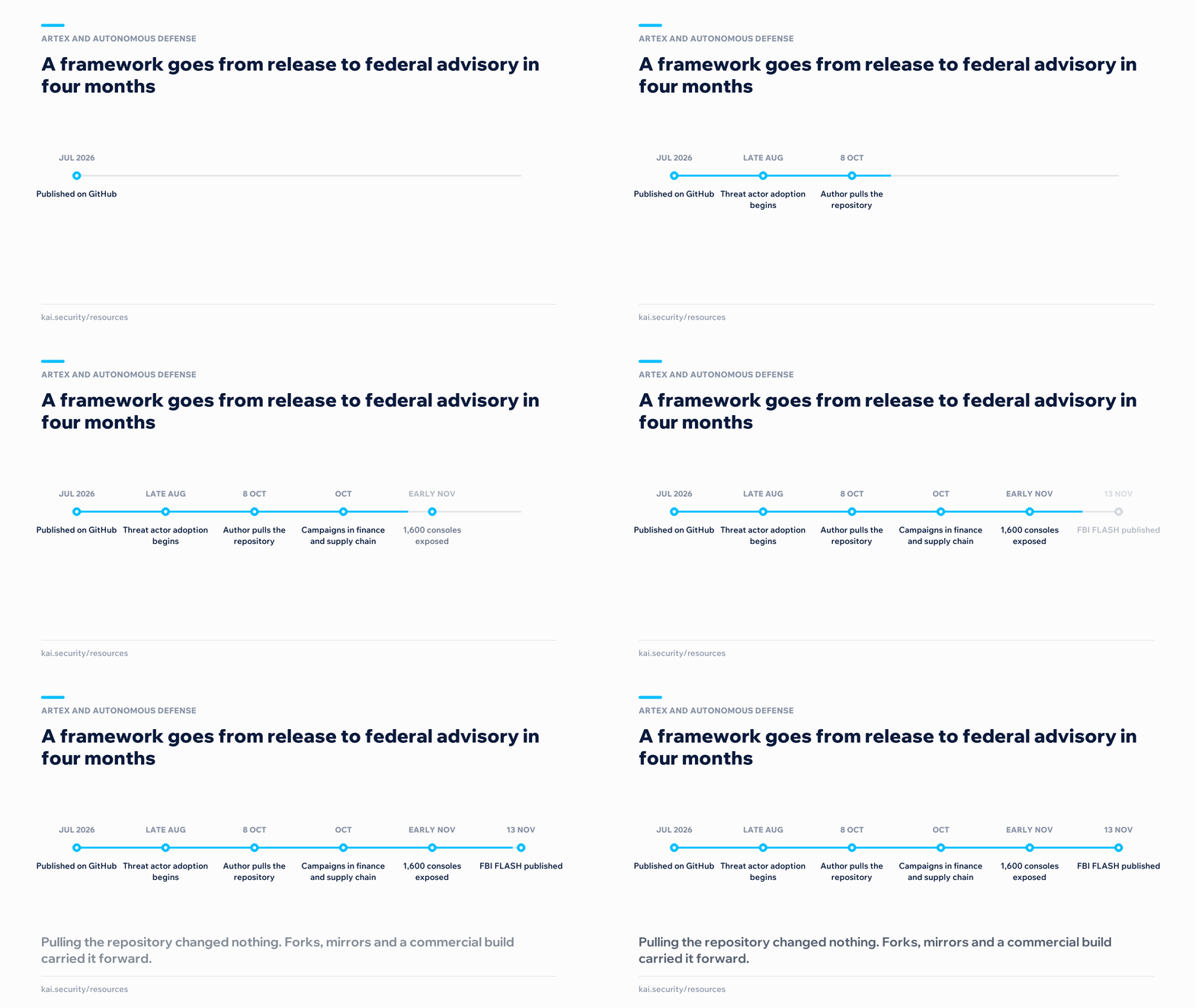
It was published on GitHub in July 2026 by a developer working as Autumn-27, reached somewhere between 1,500 and 2,000 stars inside ten weeks, and was pulled by its author on 8 October after abuse reports. That did nothing. It survives in forks, mirrors, archived copies and a commercial build called ARTEX PRO. As of early November, researchers counted more than 1,600 ARTEX consoles exposed on the public internet, which is only the ones you can see from outside. It may have started as a defensive tool for penetration testing, but that didn’t stop attackers from immediately adopting it
The campaign record is not theoretical. A financially motivated operation against South Korean financial institutions exfiltrated personal information on roughly 67,000 people. A supply chain compromise through ConnectWise Cloud Backup produced attempted sign ins against more than 2,250 downstream tenants. The targeted institutions spans financial services, government, technology, defense, semiconductor, energy, healthcare, manufacturing, telecommunications, and legal.
Strip out the tooling and the attribution and one finding is left standing.
The FBI recorded some ARTEX intrusions that reached privileged access in under three hours from initial targeting. Google's incident responders put the typical path from first compromised account to deep system access at around four hours, with one case as low as fifteen minutes. Inside those windows, individual execution sequences run in bursts of two to twenty five seconds. One burst logged twenty seven distinct events in twenty three seconds.
Now set your own numbers beside those. Triage, ownership, ticket, change advisory board, maintenance window, deploy, verify.
The advisory names the consequence directly, and I would put this line in front of every security leader I know: ARTEX generates high volumes of forensically noisy traffic that may trigger alerts, but attack speed provides limited time for coordinated defender response before objective completion. Mandiant's version is blunter. These frameworks compress attack timelines to machine speed, and for now they trade stealth for velocity.
Read that carefully, because it is better news than it sounds. You will probably see it. You will probably see it while it is happening. You just cannot currently do anything about it in time.
Detection is not the failure. The interval after detection is the failure.
I want to be precise about what I am claiming, because "autonomous defense" has become a phrase people use to mean anything.
A control is something that changes an outcome. If your process reliably produces an accurate, well evidenced, correctly prioritized finding, and the exploitable condition is still there four days later, you have not operated a control. You have kept a record of what happened. The audit will pass. The intrusion will also have succeeded.
This is why I argue for autonomous defense in a specific and narrow sense, rather than for autonomy in general. I am not asking anyone to let a model rewrite their estate. The action that has to become autonomous is a small one: remove or neutralize the exploitable condition, inside a defined scope, fast enough to matter. Disable the exposed console. Rotate the credential. Revoke the consent grant. Block the path. Quarantine the integration.
Those actions are bounded, reversible and testable. They are also exactly the actions that are currently waiting in a queue for the next change window.
If the attack executes without a human in the loop, the defense cannot require one in the loop and still be called a meaningful control. That is the entire argument, and I do not think there is a way around it.
None of that means you should trust it by default, and I would not.
The exposure has to be validated by something other than the system that found it, because automation inherits the discovery layer's error rate and multiplies it by throughput. The action has to be verified by something other than the system that took it. The evidence has to be inspectable without trusting the reasoning, which means artifacts a responder or an auditor can evaluate on their own. And the authority has to be bounded externally and revocable, not instructed in a prompt, because a system told to stay in scope is following a suggestion while a system that cannot exceed its scope is inside a control.
There is a sharper version of this problem from the Kai Labs orginizaton raised and that I have not stopped thinking about. In a world where even professional testers struggle to keep their own agents inside the brief, how do you tell an adversary's agentic attack from either your own automation behaving badly or another organization's agents run amok? Both look like volume. Both look like speed. If you cannot answer that question for your own systems, you are not ready to give them authority, and the answer has to be in the design rather than in the incident review.
Here is the uncomfortable second order effect.
The FBI's analysis of attacker controlled ARTEX instances found that Chinese models dominate usage, with the DeepSeek Flash family most prevalent, and it is explicit about why: capability, low cost, and a lack of observable guardrails when the task is framed as penetration testing.
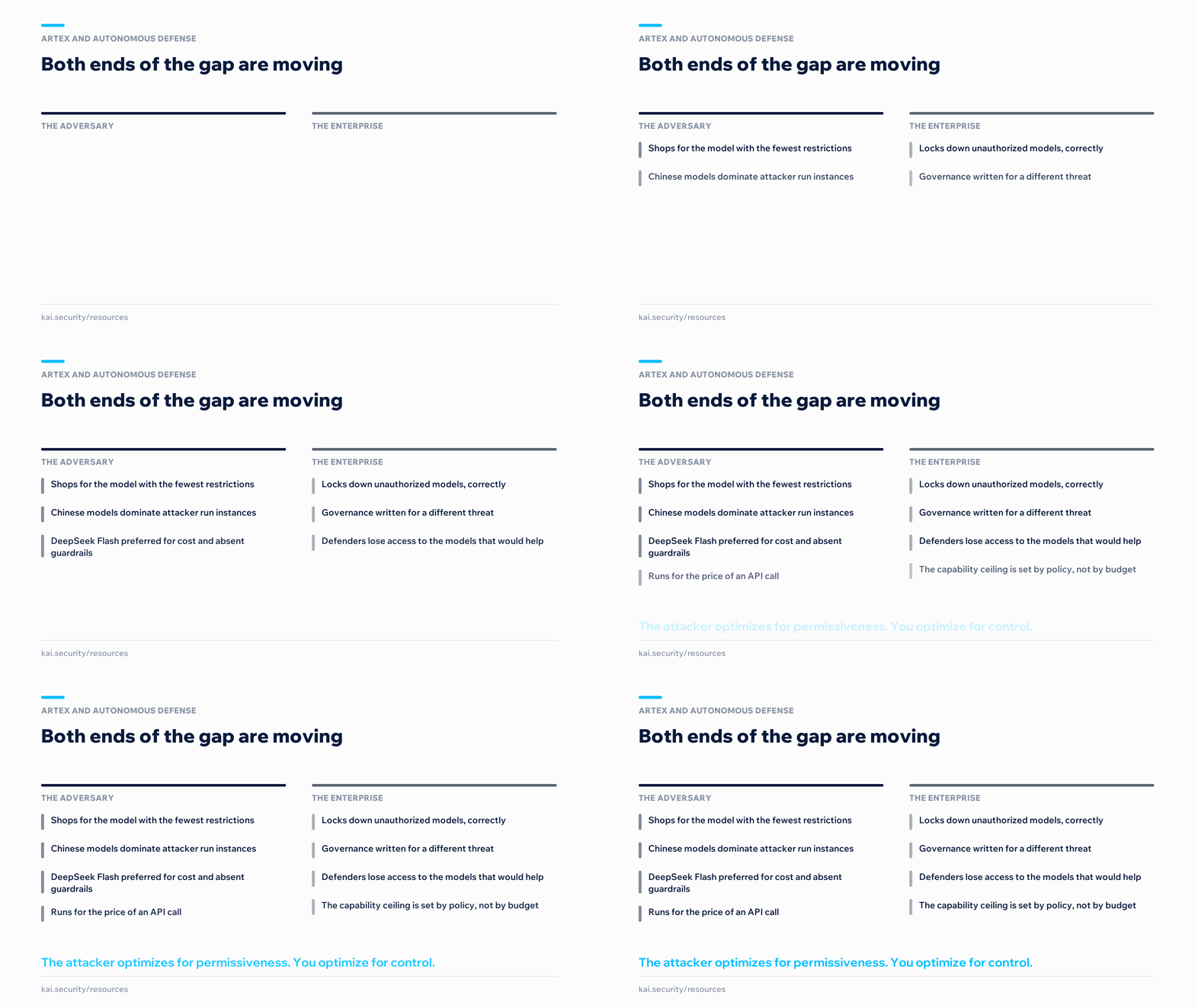
So the attacker shops for the model with the fewest restrictions. Meanwhile a responsible enterprise, doing exactly what its AI governance program told it to do based on industry best practice, locks down unauthorized models and in the process removes its own defenders' access to the models that would help them defend. The adversary optimizes for permissiveness. You optimize for control. The gap widens from both ends.
I do not have a clean fix for this and I distrust anyone who claims one. But naming it is not nothing. If your model governance has quietly become a defensive capability ceiling, that is a decision your security leadership should be making deliberately, with the tradeoff written down, rather than inheriting it from a policy written for a different threat.
I want to be careful not to let any of this sound like an argument for skipping the basics while you rearchitect.
Look at how ARTEX actually gets in. Unsigned SAML assertions. Exposed Kudu and SCM endpoints. Hardcoded administrator passwords in JavaScript bundles. Missing authentication on web APIs. Stolen VPN configurations and leaked credentials. Cross account cloud trust abused from a partner tenant. Insecure direct object references.
There is nothing novel in that list. What is novel is that enumerating and chaining it no longer costs the attacker expertise, time, or money.
Network segmentation, least privilege, and credential rotation are not basics you outgrow. Today more than ever, they decide whether a three hour intrusion reaches anything worth having. Agentic tooling is extremely good at finding the peripheral system nobody owns: the partner portal, the mobile backend, the sales support app, the service somebody stood up in a different business unit. Your posture cannot be allowed to slip while you adapt, which is the trap I expect a lot of teams to walk into over the next year.
And do not treat the published indicators as the perimeter of the problem. ARTEX is the most widely used of these frameworks. It is not the only one. Google is already tracking CAIRN, CyberStrikeAI and PentAGI, along with forks like ScopeWeaver. The FBI's own indicator file says it plainly: these should not be considered standalone indicators of ARTEX activity. Hunt the behavior, not the list.
One last point, and it is the one I would want a board to hear.
This tempo is being absorbed by people. Not by a platform, not by a roadmap, by a small number of individuals who are now expected to be awake for bursts that complete in twenty three seconds and investigations that start at midnight. That pace would burn out the most battle hardened team you have ever worked with, and burnout in a security organization does not show up as a resignation. It shows up first as a missed alert.
If I am honest, that is a large part of why I believe the autonomy argument rather than merely accepting it. Autonomous defense is not a staffing efficiency story. It is the only version of this where the work is survivable.
We are not going to out- hire a framework that runs for the cost of an API call. We can out- design and out -secure it.
Damiano Bolzoni is Co-Founder and CTO at Kai.
Every number used above, with its source. Nothing in the body is asserted beyond this list.
To follow research from Kai, follow Kai Labs


