


Blog
11.11.26
Kai EASM: Attackers Start Outside. Now the Kai Autonomous Defense Platform Does Too

Damiano Bolzoni
Co-founder & CTO
Every exposure management program has a blind spot it rarely talks about: the part of the organization it never knew to look at. A subdomain spun up for a campaign three years ago. The web estate that came with an acquisition. An API a product team published without telling security. An AI service someone stood up to test a model and never took down.
Attackers don't need an asset inventory to find these. They start from the outside, the same way anyone on the internet can, and they work inward. Most security teams do the opposite. Their scanners, agents and connectors look at the assets they already know about, which means the exposures that sit outside that list are often the ones nobody is watching.
Today we're announcing the Kai Autonomous Defense Platform with EASM, which extends the platform to the external attack surface. The platform that already manages your assets, prioritizes your exposures and drives them to remediation now starts where attackers do. It's available now.
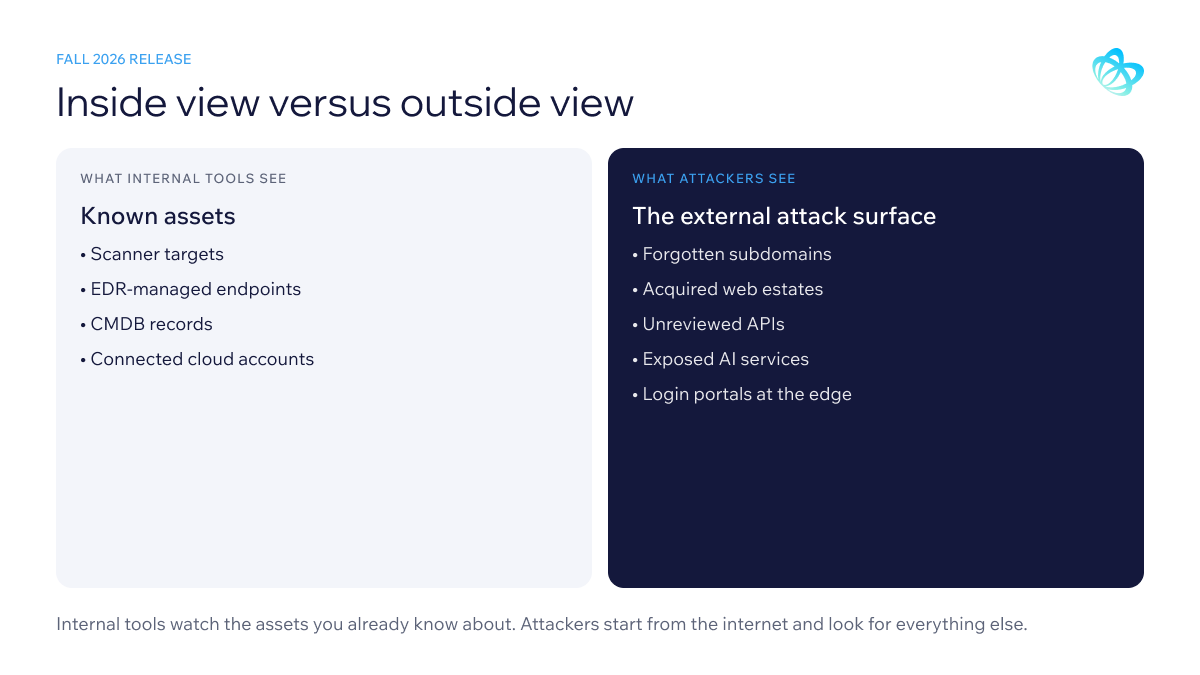
Most organizations already watch their external attack surface in some form. Usually it's a separate tool: it discovers internet-facing assets, gives each one a score, and produces a list. That list then has to be reconciled, by hand, with everything else the security team knows. Who owns this host? Is it already covered by a scanner? Does this finding duplicate one we're already tracking? Which business process depends on it?
Those questions are where external findings stall. The outside view sits in its own console, with its own inventory and its own risk scores, disconnected from the owners and workflows that could actually close the exposure. Discovery happens, but the fix doesn't.
We don't think the answer is a better list. The answer is to put the outside view in the same place as everything else.
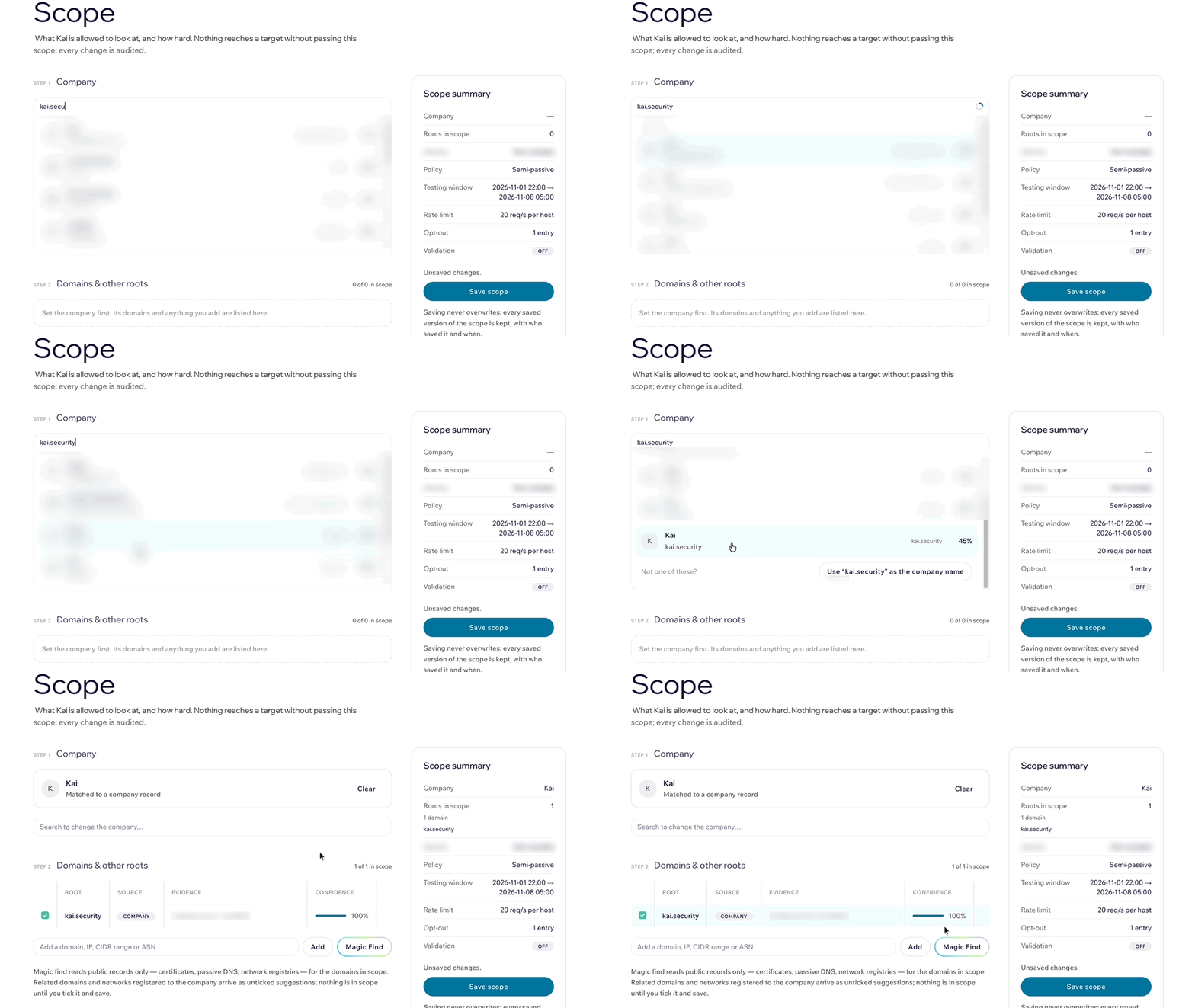
Start from a company name. Type in your company name. Kai resolves the legal entity, its domains and its subsidiaries, and you confirm them and sign a scope authorization before anything is scanned. From there, Kai discovers your internet-facing assets passively, using sources such as certificate transparency, passive DNS and internet-scan data, and attributes each one to your organization with the reasoning shown. If Kai isn't confident an asset belongs to you, it says so instead of guessing.
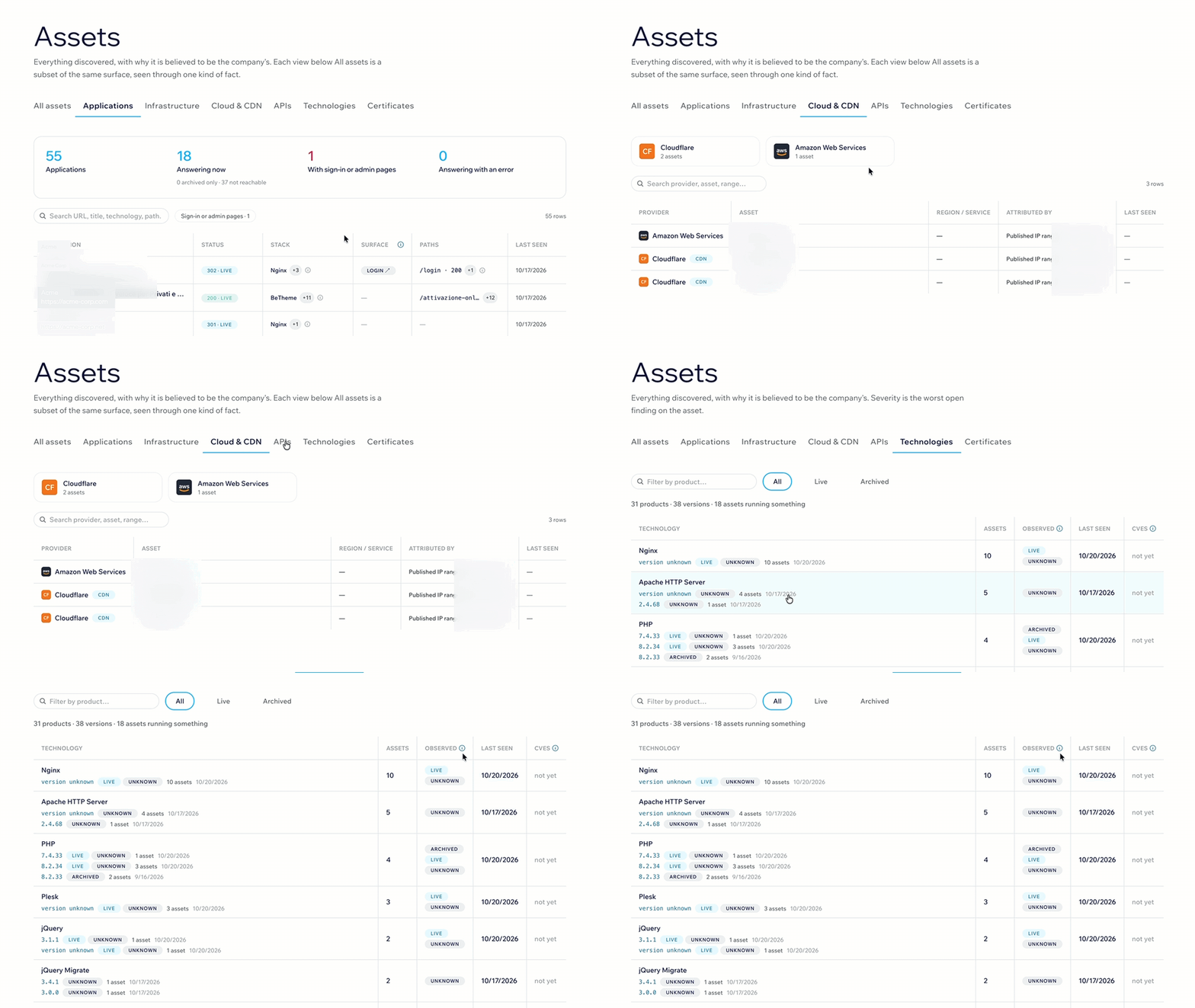
See what attackers see, including what inventories miss. Discovering hosts and open ports is table stakes. Kai fingerprints what actually runs on each asset and matches technology and version to known vulnerabilities, and it also covers the parts of the external surface that attackers increasingly target:
An agent that investigates like an attacker. Rules catch known patterns. The odd host, the unexpected service or the chain of small issues usually needs an analyst's time. Kai includes an AI agent that follows those leads the way an attacker would: it picks the most promising lead, chooses the right tool, interprets the result and records why it looked there.
The agent works inside hard limits. It can't do more than a human operator could under the same scope authorization, nothing reaches a target without passing Kai's scope gate, and every action and its reasoning are written to an audit trail your team can review.
One record, inside and outside. This is the part that makes the release more than another external scanning tool. Every external exposure arrives in Kai in the same format as your other security findings and is matched to the assets Kai already knows, using keys such as DNS names, IP addresses, certificates and cloud details. That means an internet-facing exposure inherits the owner and business context Kai has already established, and it moves through the same prioritization and remediation workflow as everything else. No separate console. No second inventory. No spreadsheet to reconcile.
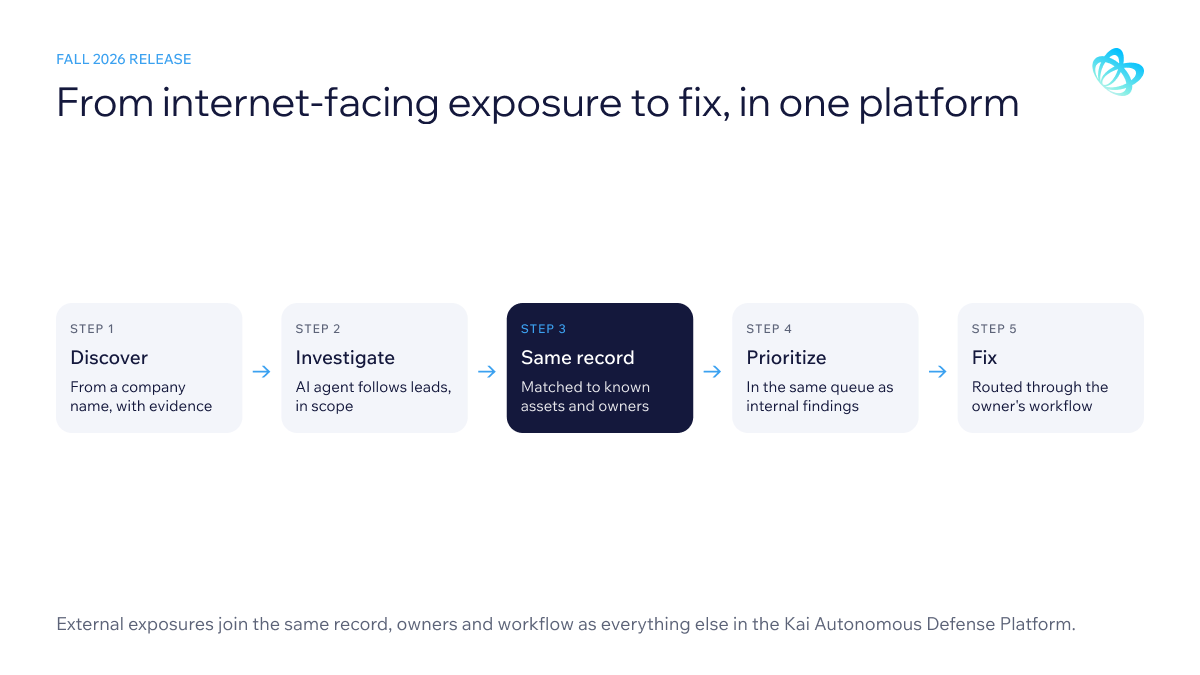
If you run a continuous threat exposure management (CTEM) program, the external attack surface belongs at the very beginning, in scoping and discovery. In most programs it's bolted on: a separate feed that someone imports, re-scores and tries to match against the internal inventory. In Kai, the outside view is part of the same cycle. External assets join the inventory your team already scopes against, external exposures are prioritized in the same queue as your internal findings, and they're mobilized to owners through the same workflow. You cover the whole surface without adding a stage, a console or a reconciliation step.
It also changes the conversation with leadership. Instead of reporting internal risk and external risk from two different tools with two different scoring models, you can report one picture of exposure, inside and outside, and show how it trends as fixes land.
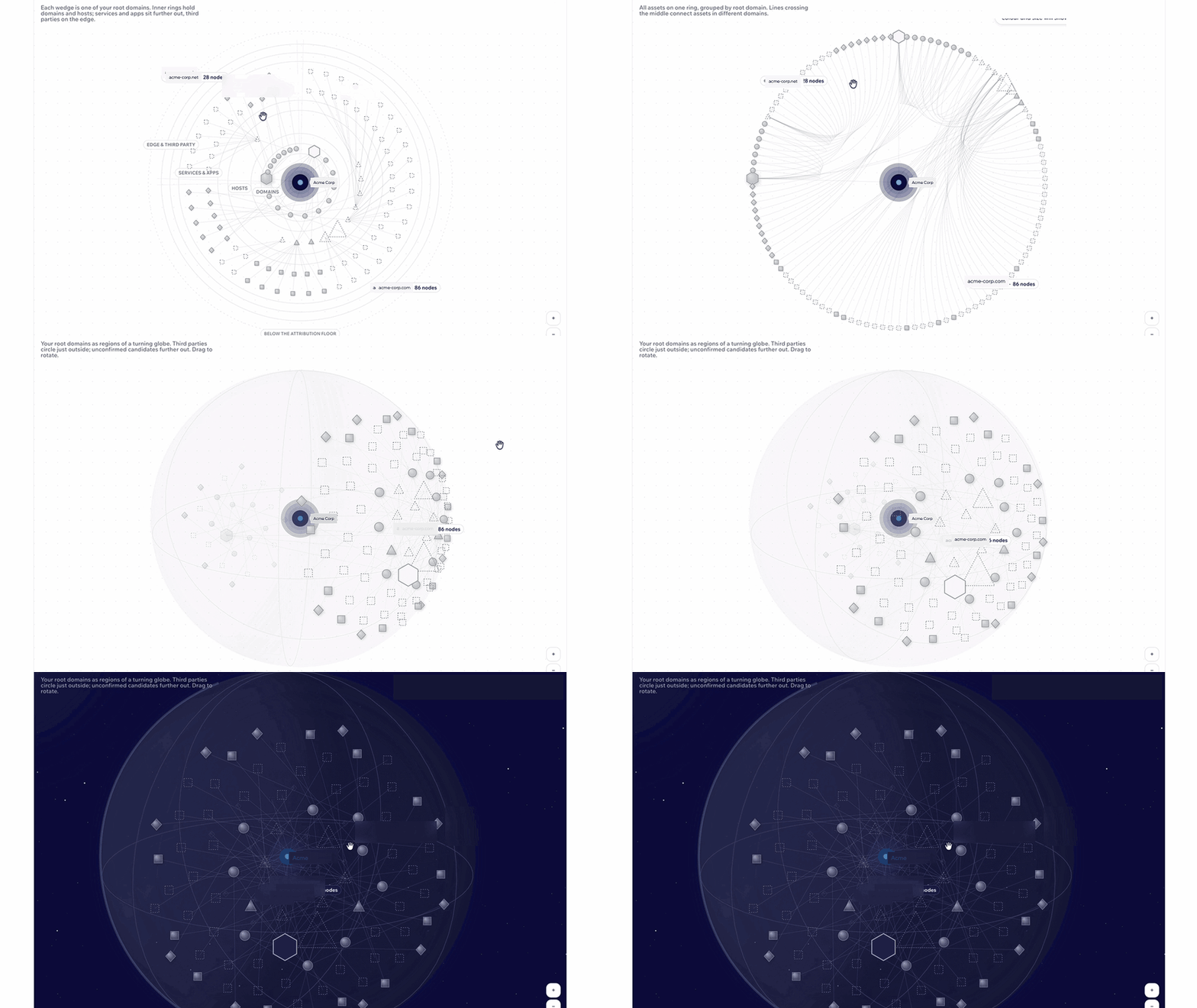
The external surface changes every day, so Kai rescans it on a schedule, shows you what's new, changed or gone since the last run, and alerts you when something needs attention. The attack-surface map lays your internet-facing estate out in one view, so you can see how it fits together and where the exposures cluster.
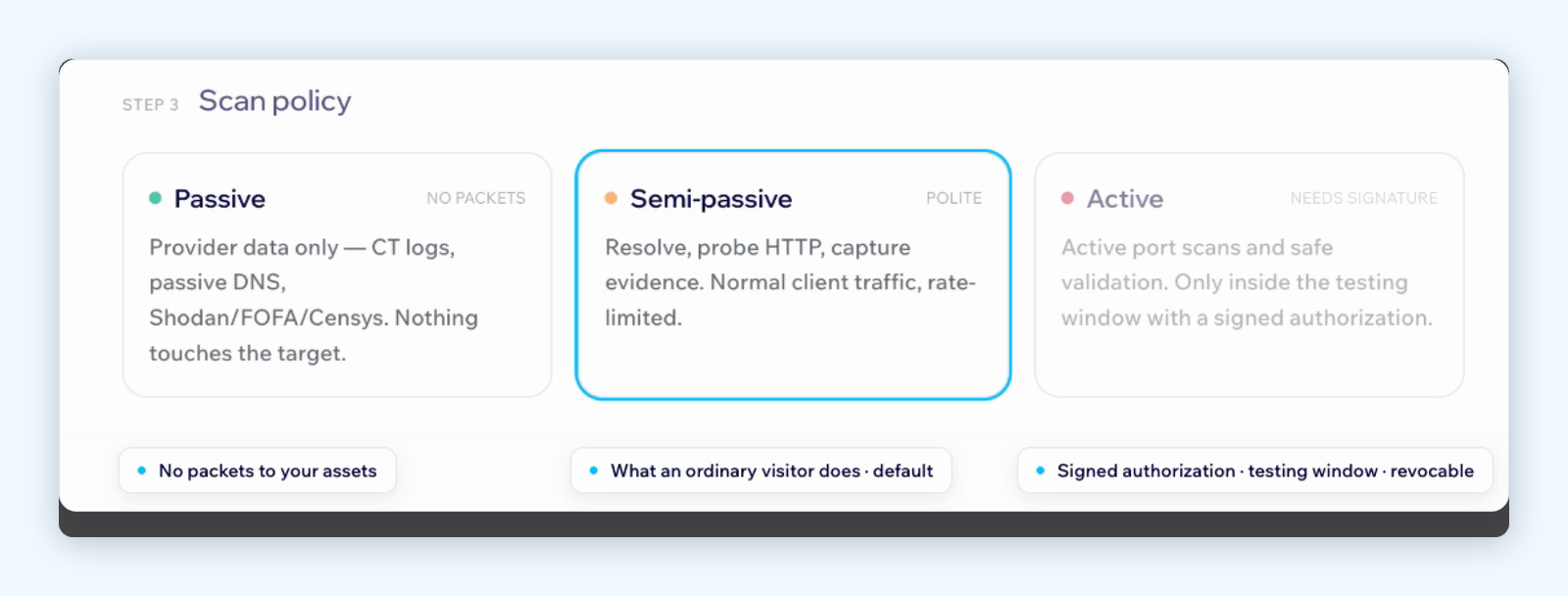
Discovery that wanders onto assets you don't own creates legal and operational risk, and it's a fair question to ask of any tool that touches the internet on your behalf. By default, Kai's discovery is passive or limited to ordinary-visitor requests that change nothing on your systems. Every outbound request goes through a scope gate, any active step requires a signed authorization and a time window, and every scope decision is recorded. When your legal or risk team asks whether a scan was authorized, you can show them.
This EASM release includes company-name discovery and attribution; technology, API and exposed-AI detection; identity attack-surface mapping; external exposures with severity and remediation guidance; the attack-surface map; the AI investigation agent; scheduled rescans with change alerts; and delivery of every external exposure into Kai's prioritization and remediation workflow.
Next on the roadmap: safe, non-destructive validation that confirms an external exposure is real, attack paths that continue from an internet-facing entry point to the internal asset at risk, and exploitability ranking driven by known exploitation and threat intelligence.
If you already use Kai, this is your platform reaching further, not another product to buy, deploy and reconcile. If you're evaluating Kai, it's the outside-in view your exposure program has been missing, in the same place you'll fix everything else.


