


Blog
11.17.26
KAI EASM: Why We Taught Our Platform to Look From the Outside In

Damiano Bolzoni
Co-founder & CTO

The Kai Autonomous Defense Platform: Fall 2026 Release extends the platform to the external attack surface, instead of adding another tool next to it. Starting from a company name, Kai finds what an organization exposes online, including domains that came with acquisitions, exposed AI services and API endpoints, and shows the evidence for each asset.Every external exposure joins the same asset record, owners and remediation workflow as everything inside. No second console and no spreadsheet in the middle. Discovery is passive by default, nothing reaches a target without passing a scope gate, and every decision is written to an audit trail.
When we started Kai, we made a bet: finding exposures was never the hard part of security. Fixing them was. The industry had built tool after tool that produced longer lists, and teams were drowning in them. So we built a platform to carry each exposure from the moment it's found to the moment it's fixed, with machines doing the work inside boundaries people set. We call that the Path to Zero.
There was a gap in that bet. You can only fix what you can see, and most organizations see themselves from the inside. Their scanners, agents and connectors look at the assets they already know about. Attackers don't start there. They start from the outside, from the same internet everyone else can reach, and they look for the things nobody on the inside knew to protect.
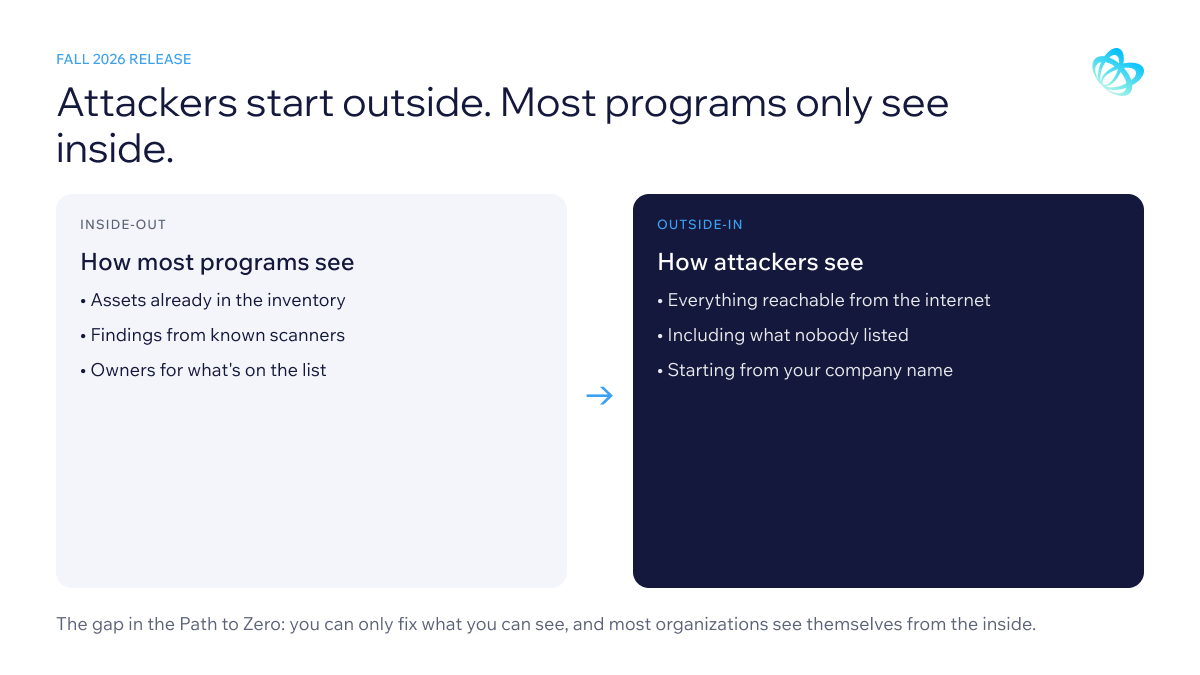
The obvious answer would have been to build an external attack surface management product and sell it next to everything else. We decided against it, and the reason goes back to the original bet.
External attack surface tools are good at discovery. What happens next is the problem. The findings live in a separate console, with a separate inventory and separate risk scores, and someone has to reconcile them by hand with everything else the security team knows. Who owns this? Is it already covered? Does it matter? That reconciliation is exactly the kind of handoff where exposures go to wait, and we've spent years removing those handoffs, not adding new ones.
So we didn't build a new product. We extended the platform. With the Kai Autonomous Defense Platform: Fall 2026 Release, the platform now reaches the external attack surface.

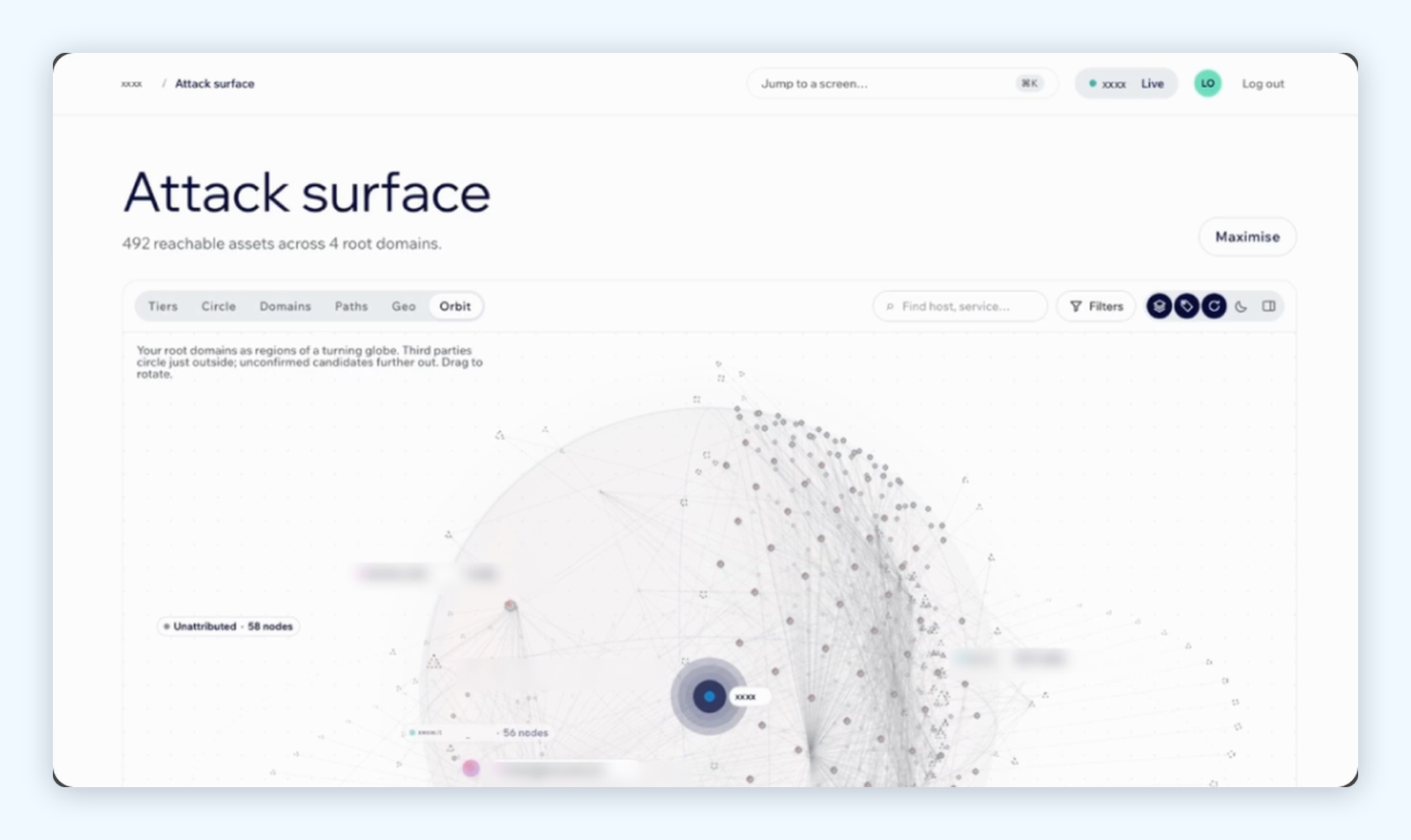
Kai now starts from a company name. It finds the domains an organization owns, including the ones that came with acquisitions, discovers the assets they expose to the internet, and shows the evidence for why each one belongs to it. It covers the parts of the external surface attackers increasingly go after: exposed AI services such as LLM endpoints, MCP servers and vector databases, and API definitions broken down into the individual endpoints they expose.
And it looks at that surface the way an attacker does, not the way an auditor does. A rating tells you how you score. Kai shows you what can be reached, what can be used, and what to fix first.
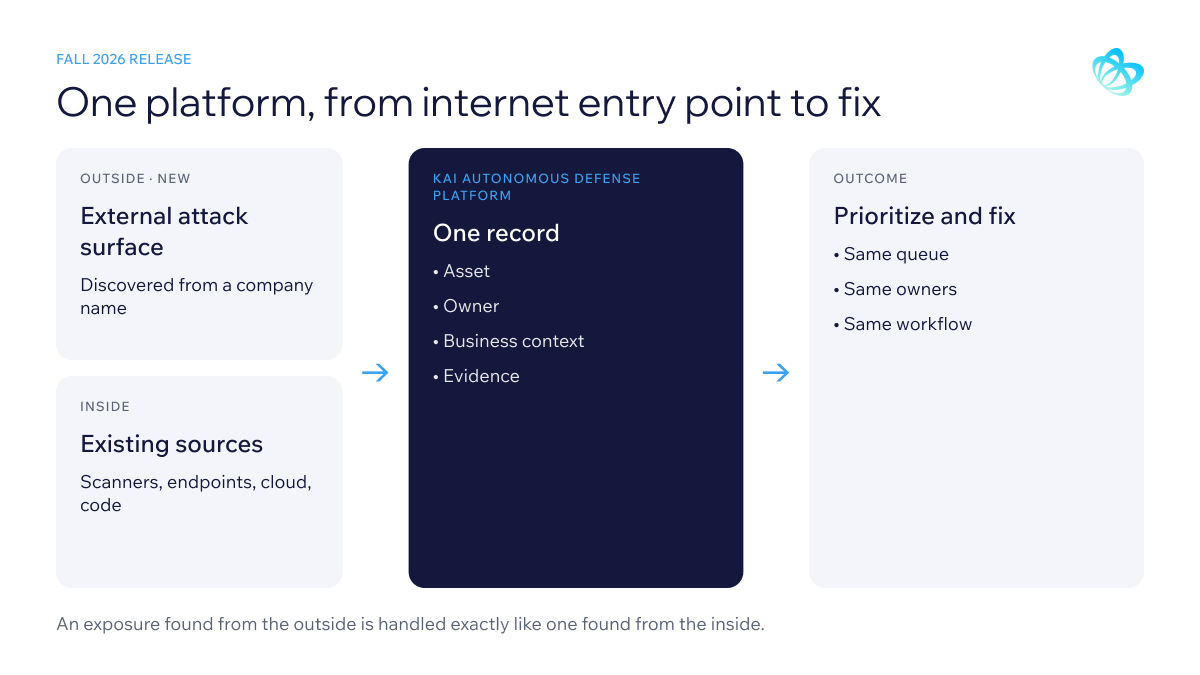
The part I'm proudest of is the least visible. Every external exposure joins the same asset record, owners and workflow as everything else Kai manages. It's matched to the assets we already know, inherits their business context, and is prioritized and routed for remediation in the workflow your teams already run. There's no second console and no spreadsheet in the middle. An exposure found from the outside is handled exactly like one found from the inside, because to an attacker there's no difference. If an attacker can find it, it belongs in your queue.
We've always believed autonomy has to be earned, and that's doubly true for anything that touches the internet on a customer's behalf. Kai's external discovery is passive by default, or limited to the requests an ordinary visitor would make. Nothing reaches a target without passing a scope gate, any active step requires a signed authorization, and every decision is written to an audit trail a person can review. People set the boundaries; machines work inside them.
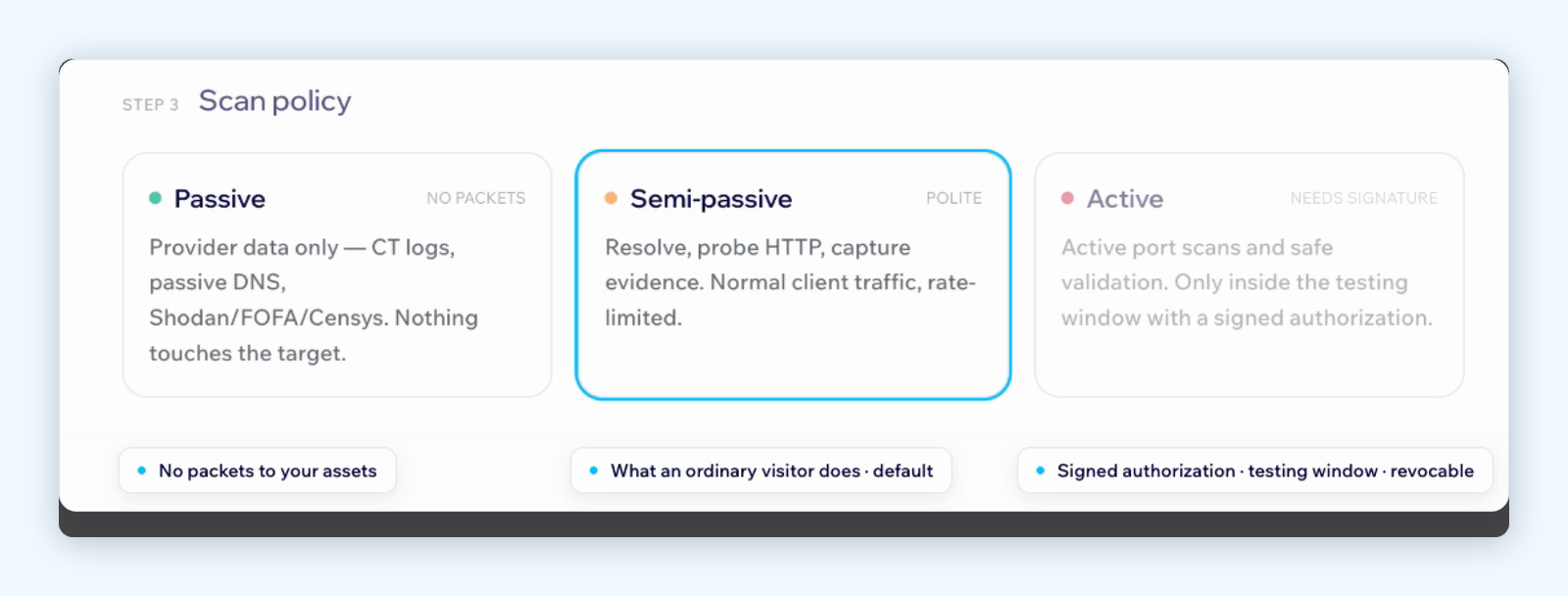
Passive, semi passive or active. Active steps need a signed authorization inside a testing window.
That conviction runs through the whole release. It also introduces Kai Labs, our applied research arm, where AI scientists and security experts work on the central problem in AI driven autonomous defense: trust. Kai Labs stress tests the guardrails that keep AI in bounds, starting with our own, and publishes what it learns for the wider security community.
The Fall 2026 Release also brings threat intelligence that is ready to act on, available to customers now. Every threat shows how reliable its sources are and whether your detections already cover it, and detection rules for Microsoft Sentinel arrive with an explanation and results tested against your own logs.
The Path to Zero was always about closing the gap between finding and fixing. Now it starts where attackers do. If you'd like to see your organization the way an attacker sees it, and fix what you find in the same place.


