


Blog
11.24.26
Where the Evidence Lands in the Zimbra and vCenter Exploits (CVE-2026-73571 and CVE-2026-123890)

Ian Hanley
This week's reporting brought 2 vulnerabilities that look nothing alike and set defenders the same trap.
CVE-2026-73571 is an authorization bypass in Zimbra Collaboration (ZCS). Any user with an ordinary mailbox can send email as another user on the same mailbox server, from the victim's real mailbox on the organization's own mail server. Zimbra fixed it in ZCS 10.1.17 on 28 May 2026.On 20 November, Rapid7 shipped a Metasploit module for it.
CVE-2026-123890 is a critical (CVSS 9.8) authenticationbypass in the VMware Directory Service of vCenter Server. An unauthenticated attacker who can reach the service gets a session as administrator@vsphere.local.Google Threat Intelligence Group (GTIG) and Mandiant found ARMORY CASTLE, a suspected PRC-nexus espionage actor, exploiting it as a zero-day from earlySeptember 2026. Broadcom fixed it on 19 November, and CISA added it to theKnown Exploited Vulnerabilities (KEV) catalog on 20 November.
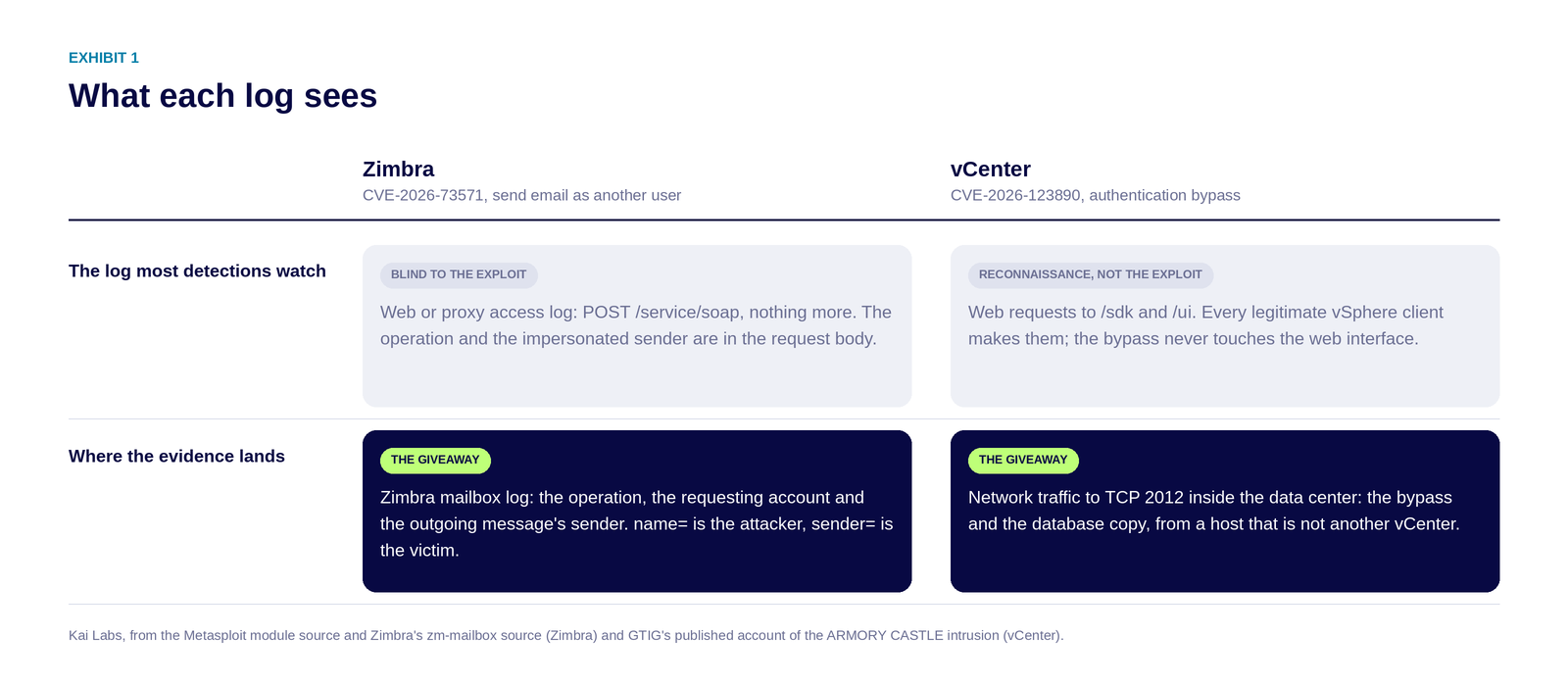
In both, the log a SOC would reach for first does not showthe exploit. Zimbra's web access log sees only a POSTto /service/soap; the operation and theimpersonated sender are in the request body. The requests to vCenter's /sdk and /ui that most published vCenter detections watch are reconnaissance; the bypass itself is anRPC exchange on TCP port 2012. The evidence lands somewhere else: in Zimbra'sown mailbox log, and in network traffic to port 2012 inside the data center.
What needs to be done now: Upgrade every Zimbra mailbox server to 10.1.17 or later. Patch every vCenter to 9.1.1.0200, 9.0.2.0200 or 8.0 U3m (5.2.5 for VMware Cloud Foundation5.x), including those already patched for the earlier vCenter bypass,CVE-2026-59309, and restrict which hosts can reach vCenter on TCP 2012, 443, 22and 5480.
What to watch for: In Zimbra's mailbox log, a message sent under an address that does not belong to the account that made the request. On the network, connections to TCP 2012on vCenter from anything that is not another vCenter or a management host.Neither shows up unless those logs and that traffic are collected.
A detection is only as good as the log behind it. When a request's meaning is in its body, or in a protocol no web log carries, a search that keys on the obvious log will look right, pass review and never fire on the attack. Kai Labs ran into exactly this with both vulnerabilities. Its first Zimbra searches looked for the operation name in the URL, where the exploitnever puts it, and its first vCenter reconnaissance search could not match the command lines GTIG published. Each problem was found by checking the searches against the attack as reported (the exploit's source code for Zimbra, GTIG's command lines for vCenter), and each was fixed in Kai's detection engine, so the fix applies to every vulnerability the engine covers, not just these 2.
Zimbra lets a user send mail on behalf of another mailbox when its owner has granted delegation or send-as rights, as an assistant does for an executive. The request that saves a draft, Save Draft Request,has a delegated mode for this. Before 10.1.17, Zimbra did not check that the caller held the grant.
The Metasploit module signs in as the attacker's own account, checks that the victim's mailbox is on the same mailbox server, and sends one SaveDraftRequest with the delegated flagset (isDelegatedReq="1") and the victim's address in the From field. Zimbra sends the message under the victim's identity, with no separate send call, and Rapid7 notes that a copy sits in the victim's own Sent folder. NVD scores it 4.3 (medium), reflecting a narrow technical impact: no data is read and nothing runs on the server. The business impact is wider: an attacker with one phished password can send email as the finance director, from the organization's own mail server and the director's real mailbox, and the checks that catch spoofed external mail have nothing to catch.
A server is exposed when it runs ZCS below 10.1.17, the attacker holds any valid mailbox password, and the victim's mailbox is on the same mailbox server. With a single mailbox server, every mailbox qualifies.
The whole exploit is in the body of a POST to /service/soap, thee ndpoint every Zimbra client uses for everything, so a web server or proxy access log records nothing but the POST. Zimbra's own mailbox log (/opt/zimbra/log/mailbox.log)does better. According to Zimbra's source code, on a default install it records every SOAP request at INFO by operation name, with the requesting account in name=, and for every outgoing message it writes a Sending message to MTA line with the envelope sender in sender= and the requesting account in name=. Kai Labs traced the vulnerable request through Zimbra10.1.16's source code: on that line, name=is the attacker and sender= is the victim.Outside this bug, an account sends under another address only with a send-as grant, from its own aliases or personas, or when it is allowed to use any Fromaddress.
Kai Labs' first rule had 4 web-log searches and 1 on IDS orWAF signatures. Reading the Metasploit module's source showed that the 4 web searches looked for SaveDraftRequest in the requested URL, where the module never puts it. They could not have match edits traffic in a standard web access log.
Kai fixed this in 2 steps in its detection engine. First, the engine now flags, for rewriting, any web search that looks for an API operation name in a URL when the vulnerability's description says the API isSOAP, XML-RPC, JSON-RPC or GraphQL; across all 1,965 searches Kai had published, the check flagged exactly the 4 Zimbra searches. Second, Kai added Zimbra's mailbox log, with its line format and the 2 messages above taken from Zimbra's source code, to the product logs its detections can read for any Zimbra vulnerability. Neither change altered any other published search.
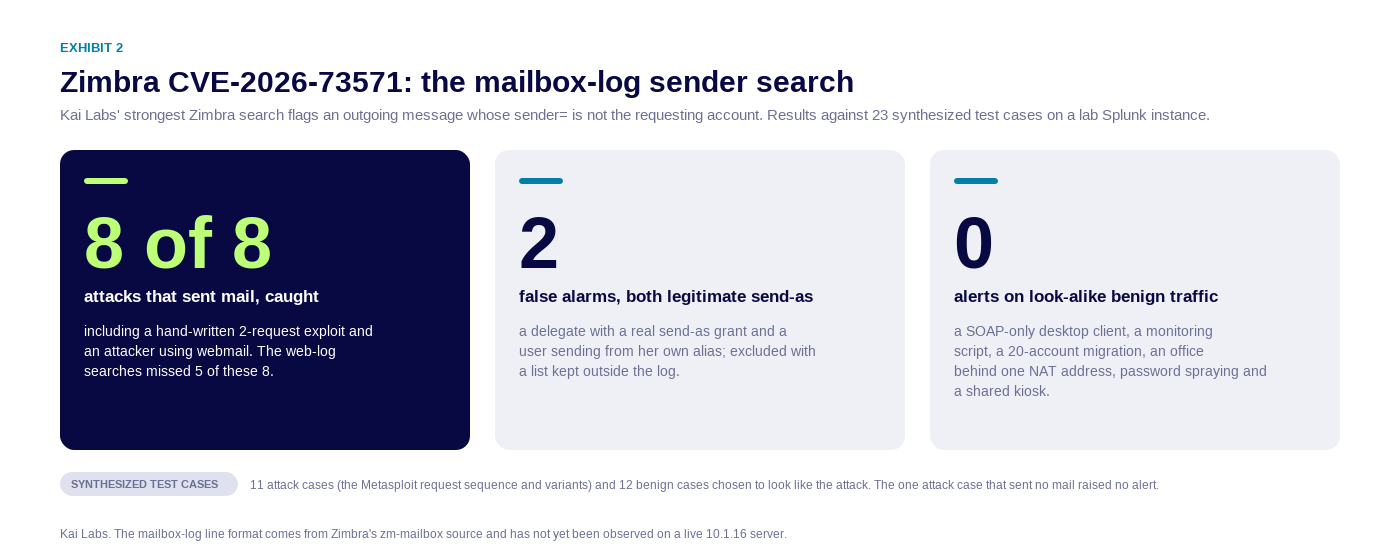
The rebuilt rule has 8 searches: 3 on the mailbox log, 4 on web access logs and 1 on IDS alerts. The strongest flags an outgoing message whose sender= is not the requesting account's own address. Kai Labs checked the rule, unmodified, on a lab Splunk instance against 23 synthesized test cases: 11 attack cases following the Metasploitmodule's request sequence and variants of it, and 12 benign cases chosen to look like the attack. Against those cases, the sender search:
· Caught every attack case that sent mail, 8 of 8, including a hand-written 2-request exploit and an attacker using webmail. The web-log searches, taken together, missed 5 of these 8, including a single default module run.
· Raised false alarms only on the 2 legitimate ways to send under another address: a delegate with a real send-as grant and a user sending from her own alias. The log does not record grants, so these areexcluded with a list of send-as grants, aliases and personas kept outside it.
· Stayed quiet on a SOAP-only desktop client, a monitoring script, a mailbox migration acting for 20 accounts, an office behind one NAT address, password spraying and a shared kiosk.
· Did not alert on the one attack case that sent no mail: a module run that stopped at its pre-flight check.
vCenter's single sign-on service is built on the VMware Directory Service (vmdir), which stores the vSphere identity domain, its accounts and the certificates that sign its authentication tokens. Alongside LDAP, vmdir exposes a DCE/RPC control interface on TCP port 2012. GTIG describes the bug as a session key disclosure in that interface: the rpc_srp_verifier service authenticates callers with the Secure Remote Password protocol (SRP-6a), and because the interface generates predictable UUIDv1 timestamps, an unauthenticated caller can obtain the shared session key without knowing any password. With it, the attacker holds a session as administrator@vsphere.local.
From there, the vmdirdbcp interface lets the attacker copy the directory database, /storage/db/vmware-vmdir/data.mdb, which holds the private key vCenter uses to sign SAML tokens. With that key, the attacker can forge a token for any user, at any time, a technique known as Golden SAML. GTIG reports that the vCenter ARMORY CASTLE compromised in September was already patched for CVE-2026-59309, an earlier bypass that reached the same goal through LDAP. That fix does not cover this one.
A vCenter is exposed when it runs a build below 9.1.1.0200, 9.0.2.0200 or 8.0 U3m, or any 7.0 (for which Broadcom lists no fixed build and directs extended-support customers to contact support), and an attacker can reach TCP 2012. No account is needed. The intrusion GTIG describes did not come from the internet: ARMORY CASTLE moved from a compromised BeyondTrust Remote Support appliance to an internal Linux appliance with no endpoint detection and response (EDR) tooling, and attacked vCenter from inside. The exposure question is what inside the network can reach vCenter on port 2012.
Most published vCenter detections key on requests to /sdk and /ui. In GTIG's account those requests are reconnaissance; the bypass never touches the web interface. GTIG describes no log of the SRP exchange, so the observable is the DCE/RPC connection to TCP 2012, and seeing it needs network telemetry or firewall logs from inside the data center.
The rest of the attack plays out on appliances and ESXi hosts: tools staged on the internal foothold, then a new SSO administrator, SSH enabled through the appliance API, and credentials read from guest virtual disks on ESXi. vCenter is an appliance that writes no Windows event log, and the Linux foothold had no EDR, so unless vCenter's logs and the network around it are collected, most of this happens out of the SOC's sight.
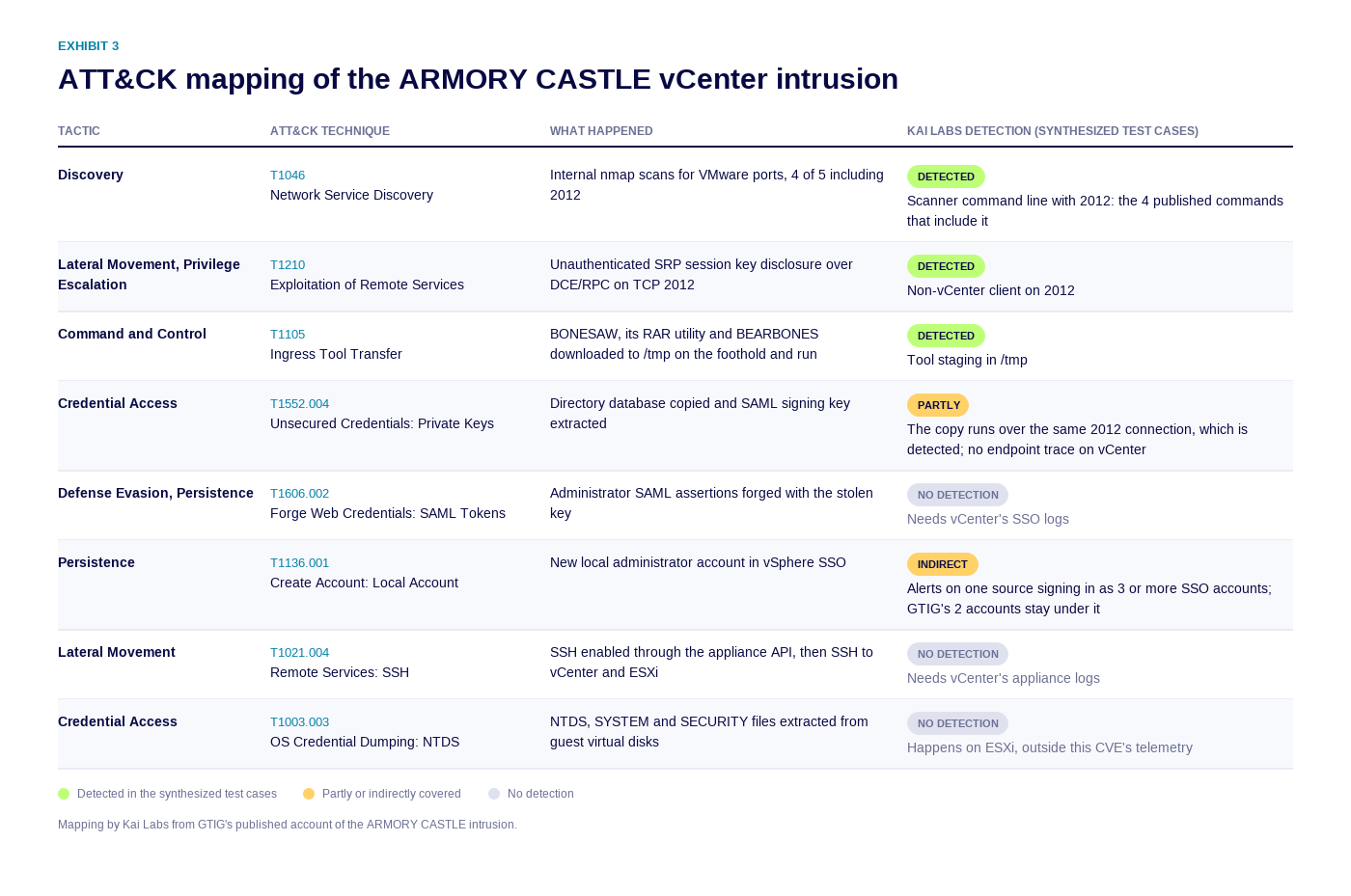
TacticATT&CK techniqueWhat happenedKai Labs detection (synthesized test cases)DiscoveryT1046 Network Service DiscoveryInternal nmap scans for VMware ports, 4 of 5 including 2012Detected: scanner command line with 2012, the 4 published commands that include itLateral Movement, Privilege EscalationT1210 Exploitation of Remote ServicesUnauthenticated SRP session key disclosure over DCE/RPC on TCP 2012Detected: non-vCenter client on 2012Command and ControlT1105 Ingress Tool TransferBONESAW, its RAR utility and BEARBONES downloaded to /tmp on the foothold and runDetected: tool staging in /tmpCredential AccessT1552.004 Unsecured Credentials: Private KeysDirectory database copied and SAML signing key extractedPartly: the copy runs over the same 2012 connection, which is detected; no endpoint trace on vCenterDefense Evasion, PersistenceT1606.002 Forge Web Credentials: SAML TokensAdministrator SAML assertions forged with the stolen keyNo detection: needs vCenter's SSO logsPersistenceT1136.001 Create Account: Local AccountNew local administrator account in vSphere SSOIndirect: alerts on one source signing in as 3 or more SSO accounts; GTIG's 2 accounts stay under itLateral MovementT1021.004 Remote Services: SSHSSH enabled through the appliance API, then SSH to vCenter and ESXiNo detection: needs vCenter's appliance logsCredential AccessT1003.003 OS Credential Dumping: NTDSNTDS, SYSTEM and SECURITY files extracted from guest virtual disksNo detection: happens on ESXi, outside this CVE's telemetry
Kai Labs built 7 Splunk Enterprise Security correlation searches, all on standard CIM data models. The 2 that matter most cover the reconnaissance and the bypass:
The others cover tool staging in /tmp on the foothold, vmdird or the token service starting a shell, data.mdb copied or written outside the directory store, and one source signing in as 3 or more vsphere.local accounts. The searches deliberately do not alert on /sdk or /ui, which every legitimate vSphere client uses. They do not cover the backdoor account, the forged SAML tokens or the SSH enablement directly, because that evidence lives in vCenter's own SSO and appliance logs, which no standard Splunk data model carries.
Kai Labs checked the searches, unmodified, against 20 synthesized test cases built from GTIG's account: 10 attack cases (6 following GTIG's command lines and 4 variants) and 10 benign cases chosen to look like the attack. The test data held no file events, so the data.mdb file-write search was not exercised. Against those cases, the searches:
The testing changed the detections. In the first version of the rule, the reconnaissance search accepted only ports written straight after -p, so it matched none of GTIG's commands. The pipeline now flags any command-line regex that requires an option's value to be attached to the option. Kai Labs also traced the SSH gap to its enrichment step, which read 10,000 of the roughly 37,000 characters in GTIG's report, around the CVE's mentions. A change that reads a long single-CVE report in full has been built but was not applied to the rule tested here.
Zimbra CVE-2026-73571
vCenter CVE-2026-123890
Kai Labs queued both CVEs for its detection pipeline on 23 November. For vCenter, the vendor advisory describes the bug in one sentence and names no port, process or log; the pipeline's enrichment step found GTIG's report on its own and pulled from it the port 2012 attack path, the rpc_srp_verifier and vmdirdbcp interfaces, the reconnaissance commands and the /tmp staging paths, and marked the /sdk and /ui requests as reconnaissance rather than exploitation. The first vCenter detections were published at 5:44 pm EST, about 15 minutes after the run started. For Zimbra, the pipeline read the CVE record, Zimbra's advisories, the Metasploit module's metadata and Rapid7's write-up, and the first detections were published at 8:28 pm EST, about 13 minutes after the run started.
The pipeline fixes described above, and the rebuilt rules, followed the same evening: the Zimbra rule with the mailbox-log searches at 9:54 pm EST and the vCenter rule at 10:46 pm EST. All times are measured from the start of the pipeline run, not from disclosure.
As of 24 November 2026:
GTIG names 5 new malware families from the vCenter intrusion (BONESAW, SAWSNAKE, BEARBONES and the web shells SLIMSAVAGE and CAGEMATCH) plus LAZYBONES, already known from earlier ARMORY CASTLE activity, and published YARA rules for all 6. It also published 11 IP addresses it labels a suspected obfuscation network of compromised third-party devices. Use them to search historical logs rather than as blocking indicators: 103.147.251[.]5, 103.190.38[.]3, 118.174.128[.]34, 118.174.128[.]36, 118.174.128[.]38, 176.9.89[.]66, 185.71.15[.]109, 220.121.128[.]41, 222.108.77[.]44, 61.216.56[.]127 and 81.45.89[.]43.
The 2 vulnerabilities reached defenders from opposite ends: vCenter's was exploited for 2 months before anyone could patch it, and Zimbra's fix was available for 6 months before an exploit became a single command. In both, the first question after patching is the same: if this attack happened here tomorrow, which log would show it? For Zimbra, the answer is the mailbox log, not the web log. For vCenter, it is network traffic to port 2012 inside the data center and vCenter's own logs, not requests to its web interface. A SIEM cannot detect an event it never receives, and a detection written against the obvious log can pass every review and still never fire.
Kai Labs has built Splunk Enterprise Security detections for both vulnerabilities and checked them against synthesized test cases built from the published attack details. Security teams that want to test the detections against their own telemetry can contact Kai. To follow more research from Kai, visit Kai Labs.
Google Threat Intelligence Group and Mandiant, report on ARMORY CASTLE's exploitation of CVE-2026-123890 in vSphere, 19 Nov 2026, https://cloud.google.com/blog/topics/threat-intelligence/armory-castle-exploits-vsphere.Broadcom, VMSA-2026-0009.1, 19 Nov 2026, updated 20 Nov 2026, https://support.broadcom.com/web/ecx/support-content-notification/-/external/content/SecurityAdvisories/0/39495.Rapid7, "CVE-2026-123890: Critical Authentication Bypass in VMware vCenter," 19 Nov 2026, updated 23 Nov 2026, https://www.rapid7.com/blog/post/etr-cve-2026-123890-critical-authentication-bypass-vmware-vcenter.Christopher Granleese, Rapid7, "Metasploit Wrap Up: Breaking Zimbra's Identity Boundaries," 20 Nov 2026, https://www.rapid7.com/blog/post/pt-metasploit-wrap-up-breaking-zimbra-s-identity-boundaries.Metasploit Framework, auxiliary/admin/http/zimbra_email_impersonation module source, https://github.com/rapid7/metasploit-framework/blob/master/modules/auxiliary/admin/http/zimbra_email_impersonation.rb.Zimbra, zm-mailbox source at tags 10.1.16 and 10.1.17 (SaveDraft.java, SoapEngine.java, MailSender.java, Zimbra Log.java, log4j.properties.production),https://github.com/Zimbra/zm-mailbox. Zimbra, Security Advisories, https://wiki.zimbra.com/wiki/Zimbra_Security_Advisories, and Security Center(ZCS 10.1.17 release, 28 May 2026), https://wiki.zimbra.com/wiki/Security_Center.CISA, Known Exploited Vulnerabilities catalog, https://www.cisa.gov/known-exploited-vulnerabilities-catalog. Mandiant, VCSAHardening & Logging Tool, https://github.com/mandiant/vcsa-hardening-tool.Detection Engineering Brief, Monday, November 23, 2026, DevSecOpsDadAttack, https://devsecopsdadattack.com/2026-11-23-detection-engineering-brief-monday-november-23-2026/.Kai Labs, research pillars and methodology, https://www.kai.security/labs#benchmark. Kai Watch enrichment records forCVE-2026-73571 and CVE-2026-123890, 24 Nov 2026 (internal).


